Introduction
Have you ever wondered what happens in the few seconds between typing a question into ChatGPT and receiving an answer?
Whether you’re asking ChatGPT to explain SEO, generate content ideas, solve a coding problem, or write an email, the response often appears almost instantly. To most users, it feels like magic. You type a question, and within seconds, an intelligent answer appears on your screen.
But behind that simple interaction lies a sophisticated process involving Artificial Intelligence (AI), Natural Language Processing (NLP), Machine Learning (ML), Large Language Models (LLMs), and advanced computing systems.
Every time you interact with ChatGPT, billions of calculations happen behind the scenes. The AI must understand your words, determine your intent, analyze context, generate possible responses, evaluate safety concerns, and then deliver the final answer.
If you’re new to conversational AI, you may also want to read our article: “How AI Chatbots Work: A Beginner’s Guide to AI Conversations.“
In What Happens When You Ask ChatGPT a Question?, we’ll explore exactly how ChatGPT processes your input, understands context, and generates responses in just a few seconds. Using simple language and real-world examples, this guide will help you understand the fascinating technology that powers one of the world’s most popular AI chatbots.
What Is ChatGPT?
ChatGPT is an advanced AI chatbot powered by a Large Language Model (LLM). It is designed to understand human language and generate human-like responses.
Unlike traditional chatbots that rely on pre-written scripts and fixed rules, ChatGPT creates responses dynamically based on patterns learned from massive amounts of training data.
Think of ChatGPT as a highly advanced language prediction system.
It has learned from books, articles, websites, conversations, and educational content. Instead of memorizing answers, it learns relationships between words, concepts, and ideas.
Real-Life Example
Imagine a student who has read millions of books and articles.
When asked a question, the student doesn’t search through every book individually. Instead, they use their accumulated knowledge to generate an answer.
ChatGPT works similarly, but at a much larger scale.
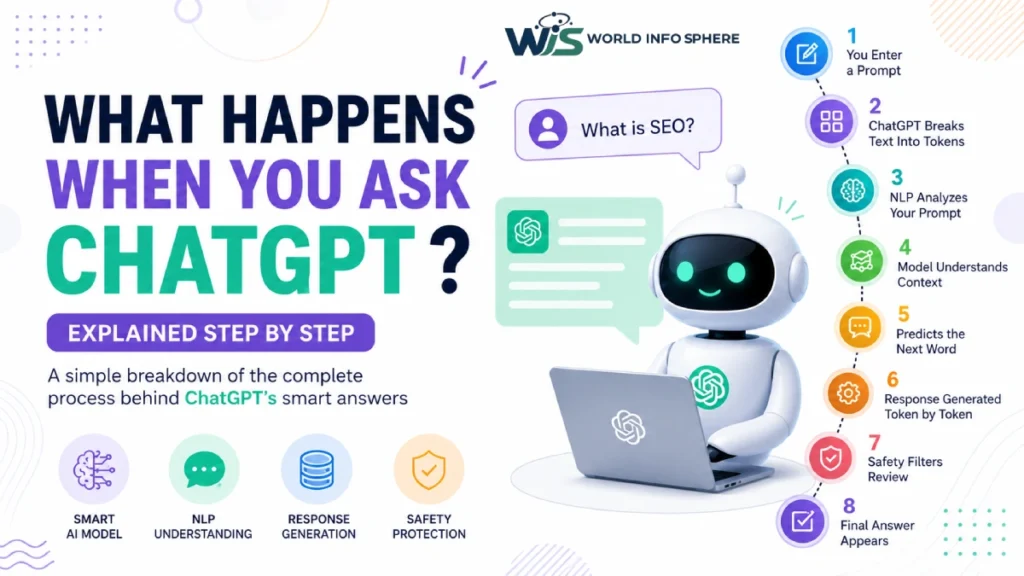
Step 1: You Enter a Prompt
Every conversation starts with a prompt.
A prompt is simply the text, question, or instruction you provide to ChatGPT.
Examples:
- What is SEO?
- Explain machine learning.
- Write a professional email.
- Give me YouTube video ideas.
Why Prompts Matter
The quality of your prompt significantly affects the quality of the response.
Poor Prompt:
“Tell me about SEO.”
Better Prompt:
“Explain SEO for beginners with real-world examples and practical tips.”
The second prompt provides more context, allowing ChatGPT to generate a more focused answer.
Real-Life Example
Imagine asking a taxi driver:
“Take me somewhere.”
The driver has no idea where you want to go.
But if you say:
“Take me to Ahmedabad Railway Station.”
The destination becomes clear.
ChatGPT works the same way.
Step 2: ChatGPT Breaks Your Text Into Tokens
Before ChatGPT can understand your message, it converts the text into smaller pieces called tokens.
Tokens may represent:
- Words
- Parts of words
- Numbers
- Symbols
- Punctuation marks
Example:
“What is SEO?”
becomes:
What | is | SEO |?
This process is called Tokenization.
Why Tokenization Is Important
Computers don’t understand language the way humans do.
To process text mathematically, ChatGPT must first break language into manageable pieces.
Real-Life Example
Imagine receiving a large LEGO structure.
Before studying it, you separate it into individual blocks.
Tokenization works similarly.
Step 3: Natural Language Processing (NLP) Analyzes Your Prompt
After tokenization, Natural Language Processing (NLP) begins analyzing your prompt.
NLP is the technology that enables computers to understand human language.
It helps ChatGPT identify:
- User intent
- Context
- Keywords
- Relationships between words
- Sentence meaning
Example
Question:
“How can I rank higher on Google?”
NLP understands:
- Topic: SEO
- Goal: Improve rankings
- Intent: Learn strategies
Real-Life Example
Suppose someone says:
“My website isn’t getting traffic.”
A human immediately understands they need SEO help.
NLP allows ChatGPT to make the same connection.
Also, read this article:
“What Is Google Gemini AI? Google’s Most Powerful AI Technology“
Step 4: The Large Language Model Understands Context
Context is one of the biggest reasons modern AI feels intelligent.
ChatGPT doesn’t only analyze your current message.
It also considers previous messages in the conversation.
Example:
User:
Tell me about Google Gemini.
Later:
How is it different from ChatGPT?
The AI understands that “it” refers to Google Gemini.
Why Context Matters
Without context:
Conversations would feel robotic.
With context:
Responses become more natural and useful.
Real-Life Example
When talking with friends, you don’t repeat the entire conversation every time you ask a follow-up question.
ChatGPT works similarly.
Step 5: ChatGPT Predicts the Next Word
This is where response generation begins.
Many people believe ChatGPT searches for answers like Google.
In reality, ChatGPT predicts the most likely next word or token.
Example:
“The capital of France is…”
The most probable continuation is:
“Paris”
The model continues making predictions until the complete response is generated.
Real-Life Example
If someone says:
“Peanut Butter and…”
Most people automatically think:
“Jelly”
Your brain predicts the next word.
ChatGPT does something similar using billions of learned language patterns.
Step 6: Response Generation Happens Token by Token
ChatGPT generates responses one token at a time.
It predicts:
First token
Second token
Third token
And so on.
Although this process occurs in milliseconds, millions of calculations happen behind the scenes.
Why Responses Differ
The quality of the response depends on:
- Prompt clarity
- Context
- Training data
- Model capabilities
This is why specific prompts often produce better answers.
Step 7: Safety Filters Review the Response
Before displaying the answer, ChatGPT passes it through safety systems.
These systems help reduce:
- Harmful content
- Dangerous instructions
- Privacy violations
- Misinformation risks
Why Safety Matters
AI is powerful.
Without safeguards, users could receive harmful or misleading content.
Also, read this aerticle: What Is AI Security? A Complete Guide to AI Threats, Risks, and Protection
Step 8: The Final Answer Appears on Your Screen
After processing, prediction, context analysis, and safety review, the final answer is delivered.
From the user’s perspective:
Question → Answer
But behind the scenes:
Prompt → Tokenization → NLP → Context Analysis → LLM Processing → Prediction → Safety Review → Response
All of this happens within seconds.
AI ChatGPT Working Process Diagram
User Prompt
↓
Tokenization
↓
Natural Language Processing (NLP)
↓
Intent Recognition
↓
Context Understanding
↓
Large Language Model (LLM)
↓
Next Token Prediction
↓
Response Generation
↓
Safety Filters
↓
Final Response
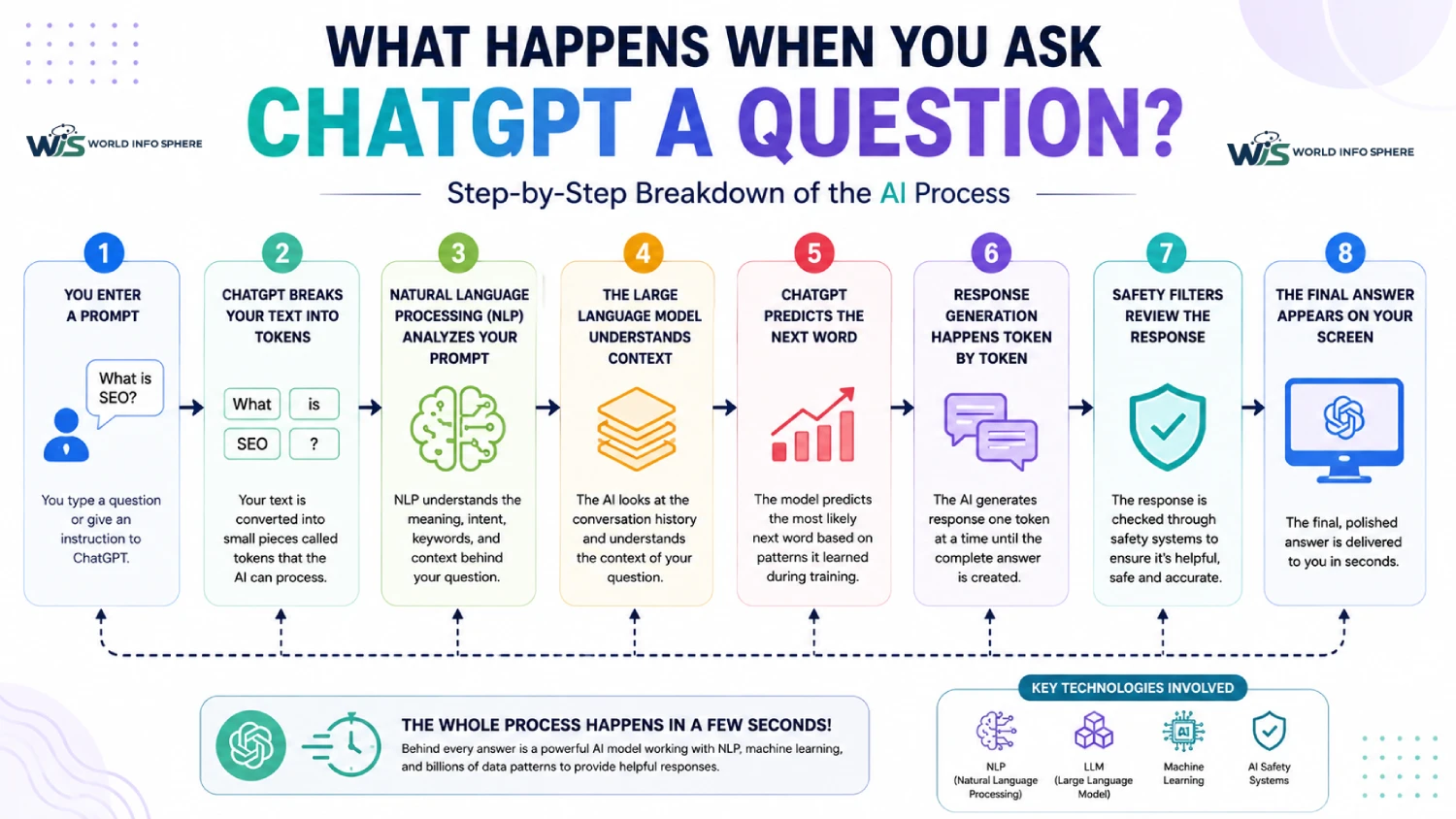
Real Example: What Happens When You Ask “What Is SEO?”
User Prompt:
“What is SEO?”
Step 1:
Prompt received.
Step 2:
Text converted into tokens.
Step 3:
NLP identifies user intent.
Step 4:
Context analyzed.
Step 5:
The language model predicts a response.
Step 6:
Response generated token by token.
Step 7:
Safety review completed.
Step 8:
Answer displayed.
Final Output:
SEO (Search Engine Optimization) is the process of improving a website’s visibility in search engine results.
ChatGPT vs Google Search
| Feature | ChatGPT | Google Search |
| Direct Answers | Yes | No |
| Conversation | Yes | Limited |
| Content Creation | Excellent | Limited |
| Latest News | Limited | Better |
| Source Discovery | Limited | Excellent |
When to Use ChatGPT
- Learning concepts
- Content creation
- Brainstorming
- Coding help
When to Use Google
- Latest news
- Official information
- Research sources
Why ChatGPT Sometimes Makes Mistakes
Despite being powerful, ChatGPT isn’t perfect.
Common reasons include:
- Ambiguous prompts
- Missing context
- Incorrect predictions
- Outdated information
- AI hallucinations
What Is an AI Hallucination?
An AI hallucination occurs when the model generates information that sounds convincing but is incorrect.
Always verify important information from trusted sources.
The Future of AI Conversations
AI technology is advancing rapidly.
Future AI systems may include:
- Better reasoning
- Voice conversations
- Real-time assistance
- Personalized responses
- Image and video understanding
Also, read this article:
- How to Earn Money Using AI Tools? Amazing Tips 2026
- Best AI Video Editing Tools | Top AI Video Editor, AI Reel Maker & AI Shorts Maker
- AI Tools for Instagram Reels & Social Media Content
- Best AI Tools for Content Creators and YouTubers
- Top 10 Free AI Tools for Students
- Top Free AI Tools You Must Use in 2026 for Productivity
Conclusion
ChatGPT may seem like it answers questions instantly, but a lot happens behind the scenes before a response appears on your screen. From understanding your prompt and breaking it into tokens to using Natural Language Processing (NLP), analyzing context, predicting the next words, and applying safety checks, every step works together to create a helpful and human-like conversation.
Understanding how ChatGPT works not only helps you appreciate the technology behind modern AI but also enables you to use it more effectively. The better your prompts, the better the responses you can receive. As AI continues to evolve, conversational tools like ChatGPT will become even more powerful, accurate, and integrated into our daily lives.
Whether you’re a student, content creator, business owner, marketer, or simply curious about artificial intelligence, learning what happens when you ask ChatGPT a question is an important step toward understanding the future of AI-powered communication.
Frequently Asked Questions (FAQs)
Does ChatGPT Search the Internet for Answers?
Not necessarily. ChatGPT primarily generates answers based on patterns learned during training.
What Is NLP in ChatGPT?
Natural Language Processing helps ChatGPT understand human language, intent, and context.
What Is a Token in ChatGPT?
A token is a small unit of text such as a word, part of a word, number, or symbol.
Why Does ChatGPT Sometimes Give Wrong Answers?
Because it predicts language patterns rather than truly understanding facts.
Can ChatGPT Learn From My Questions?
ChatGPT uses conversation context during a chat, but it does not automatically learn from every individual question in the way people often imagine.
Is ChatGPT Better Than Google Search?
Both serve different purposes. ChatGPT excels at explanations and conversations, while Google excels at finding webpages and current information.