Introduction
Imagine launching a business with a great product or service, but no one knows it exists. In today’s online world, that is one of the biggest challenges businesses face. Consumers now use Google to find information, watch videos before making purchasing decisions, follow brands on social media, and read reviews before spending money. Because of this shift in consumer behavior, digital marketing has become one of the most powerful tools for business growth.
Whether you are a small business owner, entrepreneur, freelancer, blogger, or marketing professional, understanding digital marketing is no longer optional. It is an essential skill that helps businesses reach the right audience, generate leads, increase sales, and build long-term customer relationships.
Unlike traditional marketing, digital marketing provides measurable results. Businesses can track website visitors, monitor customer behavior, analyze campaign performance, and optimize strategies based on real data. This ability to make informed decisions has transformed marketing into a more effective and efficient process.
In this complete beginner-friendly guide, you’ll learn what digital marketing is, how it works, why it matters, and the different channels businesses use to achieve success online.
What Is Digital Marketing?
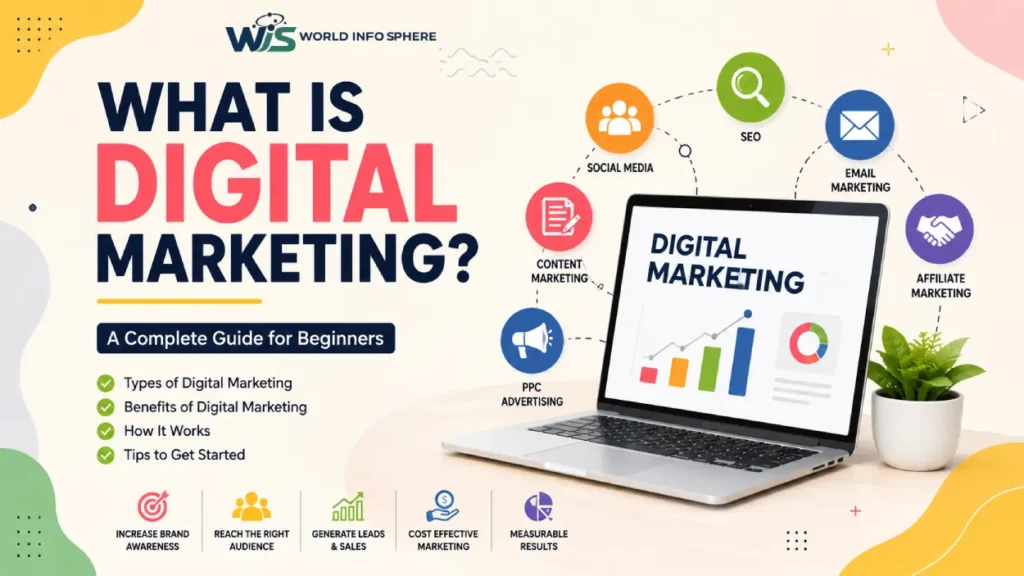
Digital marketing refers to the promotion of products, services, or brands through digital channels and online platforms. It involves using the internet and digital technologies to connect with potential customers, build brand awareness, generate leads, and increase revenue.
Digital marketing includes a wide range of activities such as:
- Search Engine Optimization (SEO)
- Search Engine Marketing (SEM)
- Content Marketing
- Social Media Marketing
- Email Marketing
- Affiliate Marketing
- Influencer Marketing
- Online Advertising
- Video Marketing
The primary goal of digital marketing is to reach the right audience at the right time using the right message.
Digital Marketing in Simple Words
In simple terms, digital marketing is any form of marketing that happens online.
When you search for information on Google, see an advertisement on Facebook, receive a promotional email, watch a YouTube advertisement, or read a blog article from a company, you are interacting with digital marketing.
Businesses use these channels to attract visitors, convert them into customers, and encourage repeat purchases.
Why Digital Marketing Is Important Today
The internet has changed how people discover products and services.
Before making a purchase, most consumers:
- Search online for information
- Compare products and prices
- Read customer reviews
- Watch video demonstrations
- Follow brands on social media
- Subscribe to newsletters
Because customers spend so much time online, businesses must build a strong digital presence to remain competitive.
Greater Visibility
Digital marketing helps businesses appear where potential customers are actively searching for solutions.
Better Customer Engagement
Brands can communicate directly with customers through comments, messages, emails, and social media interactions.
Cost-Effective Growth
Compared to traditional advertising, many digital marketing strategies deliver a higher return on investment.
Measurable Results
Businesses can monitor campaign performance and make improvements based on real-time data.
Global Reach
Even small businesses can connect with customers worldwide through digital platforms.
These advantages make digital marketing one of the most valuable business growth strategies available today.
Traditional Marketing vs Digital Marketing
Traditional marketing includes methods such as:
- Television advertisements
- Radio commercials
- Newspapers
- Magazines
- Billboards
- Flyers
While these methods still have value, they often require significant investment and provide limited performance tracking.
Digital marketing offers several advantages:
| Traditional Marketing | Digital Marketing |
| Limited targeting | Precise audience targeting |
| Difficult tracking | Real-time analytics |
| Higher costs | Flexible budgets |
| One-way communication | Two-way interaction |
| Slower optimization | Instant campaign adjustments |
For example, if you place an advertisement in a newspaper, it can be difficult to know exactly how many people saw it or responded.
With digital marketing, you can track clicks, website visits, conversions, sales, and engagement almost instantly.
How Digital Marketing Works
Many beginners assume digital marketing is simply about posting content online. In reality, it is a strategic process that combines planning, audience research, content creation, data analysis, and optimization.
Successful digital marketing campaigns typically follow four key stages.
1. Strategic Planning and Goal Setting
Every successful marketing campaign starts with clear objectives.
Businesses may want to:
- Increase website traffic
- Generate leads
- Improve brand awareness
- Increase sales
- Grow email subscribers
- Improve customer retention
Without clear goals, measuring success becomes difficult.
For example, an online fitness coach might aim to increase website traffic by 30% over the next six months. This objective helps guide future marketing decisions.
2. Understanding Your Target Audience
Knowing your audience is critical.
Businesses need to understand:
- Age
- Gender
- Location
- Interests
- Online behavior
- Purchasing habits
- Challenges and pain points
This information helps marketers create relevant content and campaigns.
For example, a company selling fitness equipment will target individuals interested in health, exercise, weight loss, and home workouts.
The better you understand your audience, the more effective your marketing becomes.
3. Content Creation and Distribution
Once goals and audience insights are established, businesses begin creating content.
Content may include:
- Blog posts
- Videos
- Social media updates
- Email newsletters
- Infographics
- Podcasts
- Case studies
Good content educates, informs, entertains, or solves problems.
For example, a running shoe company might publish articles about:
- Choosing the right running shoes
- Marathon training tips
- Injury prevention strategies
- Running techniques for beginners
This valuable content attracts visitors while building trust and authority.
After creating content, businesses distribute it across multiple channels such as:
- Google Search
- YouTube
- Email campaigns
The objective is to reach customers wherever they spend their time online.
4. Performance Analysis and Optimization
Digital marketing is an ongoing process.
Successful marketers constantly monitor campaign performance.
Common metrics include:
- Website traffic
- Click-through rate (CTR)
- Engagement rate
- Conversion rate
- Bounce rate
- Return on investment (ROI)
Analytics tools help marketers identify what is working and what needs improvement.
For example, if a blog post receives thousands of visitors but few conversions, marketers may improve the call-to-action, redesign the landing page, or adjust their targeting strategy.
This continuous improvement process helps maximize results over time.
Types of Digital Marketing
Digital marketing consists of multiple channels that work together to achieve business goals.
Each channel serves a unique purpose and helps businesses reach audiences in different ways.
Search Engine Optimization (SEO)
Search Engine Optimization (SEO) is the process of improving a website’s visibility in search engine results.
When users search for information on Google, businesses want their content to appear near the top of search results.
SEO involves:
- Keyword research
- Content optimization
- Technical SEO
- Link building
- User experience improvements
For example, if someone searches for:
“best digital marketing courses”
Google will display pages it considers most relevant and valuable.
Websites with strong SEO practices have a better chance of ranking higher and attracting organic traffic.
Why SEO Matters
SEO helps businesses:
- Increase website traffic
- Improve online visibility
- Build credibility
- Generate leads
- Reduce advertising costs
Since organic traffic can continue generating results for years, SEO remains one of the most valuable digital marketing strategies.
Search Engine Marketing (SEM)
Search Engine Marketing involves paid advertising on search engines.
Google Ads is one of the most popular SEM platforms.
Businesses bid on keywords relevant to their products or services.
For example:
A digital marketing agency might target keywords such as:
- Digital marketing services
- SEO agency
- Social media marketing company
When users search for these terms, paid advertisements can appear above organic results.
Benefits of SEM
- Immediate visibility
- Fast traffic generation
- Precise audience targeting
- Measurable performance
- Flexible budgeting
Unlike SEO, SEM requires businesses to pay for clicks, but it can produce faster results.
Content Marketing
Content marketing focuses on creating valuable content that attracts and educates potential customers.
Instead of directly promoting products, businesses provide useful information that helps audiences solve problems and make informed decisions.
Examples include:
- Blog posts
- Videos
- Guides
- E-books
- Webinars
- Case studies
Quality content builds trust, authority, and long-term customer relationships.
For example, if you’re interested in learning how online businesses generate passive income through partnerships, you can explore our detailed guide on What Is Affiliate Marketing? The Step-by-Step Guide to Making Money. This strategy is often considered one of the most effective content-driven digital marketing models available today.
Content marketing also supports SEO by helping websites rank for valuable keywords and attract targeted traffic.
Social Media Marketing
Social media has become one of the most influential digital marketing channels in the modern business landscape. Platforms such as Facebook, Instagram, LinkedIn, Pinterest, YouTube, and X allow businesses to communicate directly with their audience and build meaningful relationships.
Unlike traditional advertising, social media marketing encourages two-way communication. Customers can comment, share, ask questions, and engage with brands in real time.
Businesses use social media marketing to:
- Increase brand awareness
- Generate website traffic
- Promote products and services
- Build customer trust
- Improve customer support
- Create online communities
For example, a clothing brand can use Instagram to showcase new collections, share customer testimonials, and run promotional campaigns.
Social media is not only beneficial for businesses but also for individuals who want to build a personal brand or earn money online. Many content creators generate income through sponsorships, affiliate partnerships, and digital products.
If you want to learn more about monetizing social media platforms, explore our guide How to Earn Money from Instagram at Home.
Why Social Media Marketing Matters
Social media helps businesses stay connected with customers and remain visible in competitive markets. Consistent posting, audience engagement, and valuable content can significantly improve brand recognition and customer loyalty.
Email Marketing
Despite the rise of social media platforms, email marketing remains one of the highest-performing digital marketing channels.
Email marketing involves sending targeted messages to subscribers who have voluntarily joined a business’s mailing list.
Businesses use email marketing for:
- Product promotions
- Newsletters
- Customer updates
- Lead nurturing
- Event announcements
- Personalized recommendations
One of the biggest advantages of email marketing is direct communication. Unlike social media algorithms, businesses have greater control over reaching their subscribers.
Benefits of Email Marketing
- High return on investment (ROI)
- Personalized communication
- Increased customer retention
- Better lead nurturing
- Strong conversion potential
For example, an online store may send personalized product recommendations based on a customer’s previous purchases, increasing the likelihood of repeat sales.
Successful email marketing focuses on providing value rather than constantly pushing sales messages.
Affiliate Marketing
Affiliate marketing is a performance-based marketing strategy where individuals or businesses earn commissions by promoting products or services offered by another company.
When someone purchases through an affiliate link, the affiliate receives a percentage of the sale.
Affiliate marketing has become one of the most popular online income opportunities because it requires relatively low startup costs.
Common affiliate marketing channels include:
- Blogs
- YouTube channels
- Social media accounts
- Email newsletters
- Niche websites
For example, a technology blogger might review laptops and include affiliate links to recommended products.
If a reader purchases through those links, the blogger earns a commission.
Benefits of Affiliate Marketing
- Passive income potential
- Low investment requirements
- Flexible working opportunities
- Scalable business model
- Multiple revenue streams
If you’re interested in learning how affiliate marketing works in detail, check out our guide What Is Affiliate Marketing? The Step-by-Step Guide to Making Money.
Affiliate marketing continues to grow as businesses increasingly rely on partnerships to expand their reach.
Influencer Marketing
Influencer marketing involves partnering with individuals who have established credibility and loyal audiences within specific industries or niches.
These influencers promote products, services, or brands to their followers through content such as:
- Social media posts
- Videos
- Product reviews
- Tutorials
- Live streams
Consumers often trust recommendations from influencers more than traditional advertisements because they perceive them as authentic.
Benefits of Influencer Marketing
- Increased brand awareness
- Higher audience trust
- Better engagement
- Improved conversions
- Access to niche markets
Businesses frequently collaborate with micro-influencers because they often have highly engaged audiences despite having smaller follower counts.
As social media continues to evolve, influencer marketing remains an important part of many digital marketing strategies.
Benefits of Digital Marketing
Digital marketing offers numerous advantages compared to traditional marketing methods.
1. Global Reach
The internet allows businesses to reach customers across cities, countries, and continents.
Even small businesses can compete globally through effective digital marketing strategies.
2. Cost-Effective Marketing
Many digital marketing channels require significantly lower investment than traditional advertising.
For example:
- SEO generates organic traffic
- Social media marketing can start with a minimal budget
- Email marketing offers high ROI
This makes digital marketing accessible to businesses of all sizes.
3. Better Audience Targeting
Digital marketing platforms provide advanced targeting options based on:
- Age
- Gender
- Interests
- Location
- Online behavior
- Purchase history
This helps businesses reach the most relevant audience.
4. Measurable Results
One of the greatest advantages of digital marketing is data.
Businesses can measure:
- Website traffic
- Conversion rates
- Click-through rates
- Sales
- Revenue
- Customer engagement
These insights allow marketers to improve performance continuously.
5. Improved Customer Relationships
Digital marketing enables direct communication between businesses and customers.
Through social media, email, and personalized experiences, brands can build stronger customer relationships and increase loyalty.
6. Increased Brand Awareness
Consistent online visibility helps businesses become more recognizable.
The more often people encounter a brand online, the more likely they are to remember it when making purchasing decisions.
7. Higher Conversion Opportunities
Digital marketing allows businesses to guide potential customers through the buying journey using targeted content and optimized campaigns.
This often leads to improved conversion rates and increased revenue.
Digital Marketing and the Customer Journey
Successful digital marketing supports customers throughout every stage of their journey.
Awareness Stage
At this stage, potential customers discover a brand through:
- Search engines
- Social media
- Advertisements
- Blog content
- Videos
The goal is to capture attention and introduce the brand.
Consideration Stage
Customers begin researching solutions and comparing options.
Businesses provide:
- Educational content
- Product information
- Reviews
- Case studies
- Guides
This helps build trust and credibility.
Decision Stage
The customer is ready to make a purchase.
Businesses encourage action through:
- Promotions
- Testimonials
- Free trials
- Discount offers
- Strong calls-to-action
Loyalty Stage
Marketing does not end after a purchase.
Businesses continue engaging customers through:
- Email campaigns
- Loyalty programs
- Exclusive content
- Community engagement
Satisfied customers often become repeat buyers and brand advocates.
Key Digital Marketing Metrics You Should Track
Understanding performance metrics is essential for success.
Website Traffic
Measures the number of visitors coming to your website.
Click-Through Rate (CTR)
Shows how many people click on a link or advertisement after seeing it.
Conversion Rate
Measures the percentage of visitors who complete a desired action.
Cost Per Acquisition (CPA)
Indicates how much it costs to acquire a customer.
Return on Ad Spend (ROAS)
Measures revenue generated compared to advertising expenses.
Tracking these metrics helps businesses optimize campaigns and improve profitability.
The Role of AI in Digital Marketing
Artificial intelligence is transforming digital marketing.
AI tools help marketers:
- Create content faster
- Analyze customer behavior
- Automate repetitive tasks
- Improve advertising performance
- Personalize customer experiences
Businesses increasingly use AI-powered platforms to improve efficiency and decision-making.
To learn more, read our guide, Facebook Marketing with AI: The Complete Guide.
Businesses can also improve content planning and audience engagement through AI-powered social media tools. Learn more in Social Media Management with AI: Complete Guide for 2026.
How to Start a Career in Digital Marketing
Digital marketing offers excellent career opportunities.
Learn Essential Skills
Focus on:
- SEO
- Content marketing
- Social media marketing
- Email marketing
- Analytics
- Paid advertising
Gain Practical Experience
Start:
- A blog
- A personal website
- Social media projects
- Freelance work
Explore Freelancing
Many beginners start by offering services on freelance platforms.
Before getting started, read How to Create an Account on a Freelancing Platform? Complete Guide.
After setting up your profile, learn how to create a Gig (Step-by-Step Process for Beginners) to attract clients effectively.
The Future of Digital Marketing
Digital marketing continues to evolve rapidly.
Key trends include:
- Artificial intelligence
- Voice search optimization
- Marketing automation
- Personalized customer experiences
- Predictive analytics
- Video-first content strategies
Businesses that adapt to these changes will be better positioned for long-term success.
Conclusion
Digital marketing has transformed how businesses connect with customers. From search engines and social media to email campaigns and affiliate partnerships, digital marketing offers powerful tools for building brand awareness, generating leads, and increasing revenue. As technology continues to evolve, businesses that invest in digital marketing and adapt to emerging trends will be better positioned for long-term growth and success.
Whether you are a business owner, student, freelancer, or aspiring marketer, learning digital marketing can open doors to countless opportunities in today’s digital economy.
Also, read this post:
How AI Chatbots Work: A Beginner’s Guide to AI Conversations
What Is a White Hat Hacker? Complete Guide for Beginners
What Happens When You Ask ChatGPT a Question? A Complete Guide
Frequently Asked Questions
What is digital marketing in simple words?
Digital marketing is the promotion of products, services, or brands using online channels such as websites, search engines, social media, and email.
What are the main types of digital marketing?
SEO, SEM, content marketing, social media marketing, email marketing, affiliate marketing, and influencer marketing.
Is digital marketing a good career?
Yes. Digital marketing offers strong career opportunities, flexible work options, and growing demand worldwide.
How does digital marketing help businesses grow?
It increases visibility, attracts customers, generates leads, improves engagement, and boosts sales.
What skills are needed for digital marketing?
SEO, content creation, analytics, communication, social media management, and advertising skills.
Can I learn digital marketing for free?
Yes. Many free resources, blogs, videos, and courses are available online.