Table of Contents
Introduction to AI Tools
A few years ago, if someone mentioned Artificial Intelligence, most people imagined robots, complex coding, or technology that only experts could understand. For students, bloggers, freelancers, and small business owners, AI felt like something that belonged to large tech companies rather than everyday life.
Today, that perception has changed completely.
Whether you are writing a blog post, preparing for an exam, managing social media content, or running a small business, there is a good chance that AI can help you complete those tasks faster and more efficiently. What once seemed complicated is now becoming surprisingly easy to use.
This is exactly why AI Tools for Beginners are gaining so much attention in 2026. People are no longer asking if AI is useful. Instead, they want to know which tools are worth learning and how those tools can make daily work easier. The best part is that you do not need technical knowledge to get started. Most modern AI tools are built for ordinary users. If you know how to search on Google, write an email, or use social media, you already have enough skills to begin exploring AI.
If you are completely new to this topic, reading “What is Artificial Intelligence? (Complete Beginner Guide 2026)“ can help you understand the basic concepts before diving into specific AI tools. What makes AI exciting is not the technology itself. The real value comes from how people are using it in practical ways. A student can learn faster, a blogger can create content more efficiently, a freelancer can manage projects better, and a business owner can save both time and money.
That is why AI is becoming part of everyday work rather than just another technology trend.
What Are AI Tools?
When people hear the term AI tools, they often imagine complex software designed for programmers or technology experts. In reality, most modern AI tools are created for everyday users and are designed to make common tasks faster, easier, and more efficient.
The simplest way to understand an AI tool is to think of it as a smart digital assistant. Instead of completing every task manually, you can use AI to help with planning, research, writing, design, organization, and many other activities.
For example, imagine sitting down to write a blog article. You know the topic you want to cover, but organizing your ideas feels difficult. Rather than staring at a blank page for half an hour, an AI tool can help generate ideas, suggest headings, create an outline, or recommend related topics to explore.
The same principle applies to many other tasks. If you need a custom image for your website but have no design experience, AI image-generation tools can create visuals from a simple text description. If you want to convert a blog post into a video, AI video tools can automate much of that process and save valuable time.
A good way to think about AI is like a calculator. A calculator helps solve calculations faster, but it does not replace mathematical thinking. Similarly, AI assists with tasks and improves efficiency, while your creativity, judgment, and experience remain the most important factors.
Today, people use AI tools for a wide range of purposes, including:
- Writing blog posts and articles
- Creating images and graphics
- Producing videos and social media content
- Summarizing research and study materials
- Organizing notes and improving productivity
- Automating repetitive business tasks
This is why AI tools are becoming useful across different industries. Students use them to simplify difficult topics, bloggers use them to generate content ideas, freelancers use them to improve productivity, and businesses use them to streamline everyday operations.
One common misconception is that AI does everything automatically. In reality, the people who achieve the best results are those who treat AI as a helpful assistant rather than a replacement for human thinking. AI can save time and reduce repetitive work, but the final ideas, decisions, and creativity still come from the user.
If you would like to understand how AI assistants generate responses behind the scenes, you may also enjoy reading “What is ChatGPT and How Does It Work? (Advanced 2026 Guide with Real Examples)“ and “What Happens When You Ask ChatGPT a Question? A Complete Guide.”
Why AI Tools Are Becoming Popular in 2026
One of the biggest reasons AI is growing so quickly is that people are busier than ever.
Students have assignments, exams, and projects to manage. Bloggers and content creators need to publish consistently. Freelancers often juggle multiple clients, while business owners must handle marketing, customer support, and operations at the same time.
Everyone is looking for ways to save time without compromising quality.
This is where AI tools fit perfectly.
Instead of spending hours researching a topic, AI can help gather information faster. Instead of manually creating every piece of content from scratch, AI can assist with brainstorming and organization.
Another major reason behind AI’s popularity is accessibility.
Not long ago, advanced software was expensive and difficult to learn. Today, many AI platforms offer free versions that allow beginners to experiment without spending money.
As a result, a college student working from a laptop now has access to tools that were once available only to large companies with dedicated teams.
The technology feels practical rather than futuristic.
People are not using AI because it sounds impressive. They are using it because it solves real-world problems.
Why Beginners Should Start Using AI Tools
Many people assume that Artificial Intelligence is only for programmers, developers, or technology experts. In reality, most modern AI tools are designed for everyday users and require little to no technical knowledge.
The biggest advantage of AI is that it helps people work smarter by reducing repetitive tasks and saving valuable time. Whether you are a student, blogger, freelancer, or business owner, AI can make daily work more efficient and less time-consuming.
Instead of trying multiple tools at once, beginners should start with a single tool and learn how to use it effectively. As confidence grows, exploring other AI solutions becomes much easier.
Some key benefits of using AI tools include:
- Saving time on routine tasks
- Improving productivity and organization
- Learning new skills more efficiently
- Creating content faster
- Exploring new income opportunities
The people who benefit most from AI are not necessarily technology experts. They are individuals who stay curious, keep learning, and use AI as a tool to support their goals rather than replace their efforts.
Save Time and Increase Productivity
Time is one of the most valuable resources, yet many people spend hours on tasks that could be completed much faster. Whether it is researching information, organizing notes, replying to emails, or planning content, small repetitive tasks can consume a significant part of the day.
This is where AI tools can make a real difference. Instead of replacing human effort, they help reduce the time spent on routine work so users can focus on more important responsibilities.
For example, a blogger creating a new article often spends time researching topics, generating ideas, creating outlines, and editing drafts. AI can assist with these early-stage tasks, making the entire content creation process more efficient. The same principle applies to students, freelancers, marketers, and business owners who regularly handle repetitive work.
Productivity is not about working longer hours. It is about working smarter and removing unnecessary obstacles. That is one of the main reasons why AI Tools for Beginners continue to grow in popularity among people looking to save time and improve their daily workflow.
Learn New Skills Faster
Learning something new can feel overwhelming at first.
There is often too much information available, and beginners struggle to identify where they should start.
AI can make that process easier.
Instead of searching through dozens of websites, users can ask AI specific questions and receive explanations tailored to their current level of understanding.
For example, someone interested in AI conversations can start by reading “How AI Chatbots Work: A Beginner’s Guide to AI Conversations.“ After understanding the basics, they can use AI tools to explore concepts further and ask follow-up questions whenever needed.
This creates a learning experience that feels more interactive and personal.
Many people who once felt intimidated by technology are discovering that AI can actually help them learn new skills faster and with greater confidence.
Create Content Without Technical Knowledge
Content creation is one of the most important digital skills today.
Businesses need content to attract customers. Bloggers need content to increase traffic. Social media creators need content to engage their audience.
The challenge is that not everyone has experience in writing, graphic design, or video editing.
AI helps bridge that gap.
A beginner can use AI to brainstorm blog topics, generate social media captions, create images, and even produce short videos. Tasks that once required multiple tools and advanced skills can now be completed much more efficiently.
For example, a content creator might use ChatGPT for idea generation, AI image tools for visuals, and video creation software to repurpose content for social media platforms.
If you want to understand how AI generates answers and assists with content creation, you can also explore “What is ChatGPT and How Does It Work? (Advanced 2026 Guide with Real Examples)“ for a deeper understanding of the technology.
Opportunities to Earn Money Online
One of the biggest reasons behind the growing popularity of AI is its connection to online income opportunities. Every day, people come across stories of freelancers completing projects faster, bloggers publishing content more consistently, and businesses using AI to improve productivity. Naturally, this raises an important question: can AI actually help someone earn money online?
The answer is yes, but not in the way many people expect. AI is not a magic tool that generates income automatically. Instead, it helps individuals work more efficiently, save time, and scale their existing skills. When combined with knowledge, creativity, and consistent effort, AI can become a powerful productivity partner.
For example, a writer can use AI to brainstorm ideas, create outlines, and speed up the research process. A freelancer can handle more projects by reducing the time spent on repetitive tasks. Digital marketers often use AI to generate content ideas, analyze trends, and improve campaign performance, while business owners can automate routine activities and focus more on growth and customer relationships.
The people who benefit most from AI are usually those who view it as a tool rather than a shortcut. Instead of replacing hard work, AI helps amplify it. Those who learn how to combine AI with real-world skills often discover new opportunities in freelancing, blogging, digital marketing, content creation, and online business.
If you are interested in exploring practical ways to generate income with AI, you may also find our guide “How to earn money using AI Tools? Amazing Tips 2026“ helpful. It covers real-world strategies being used by freelancers, bloggers, and online entrepreneurs today.
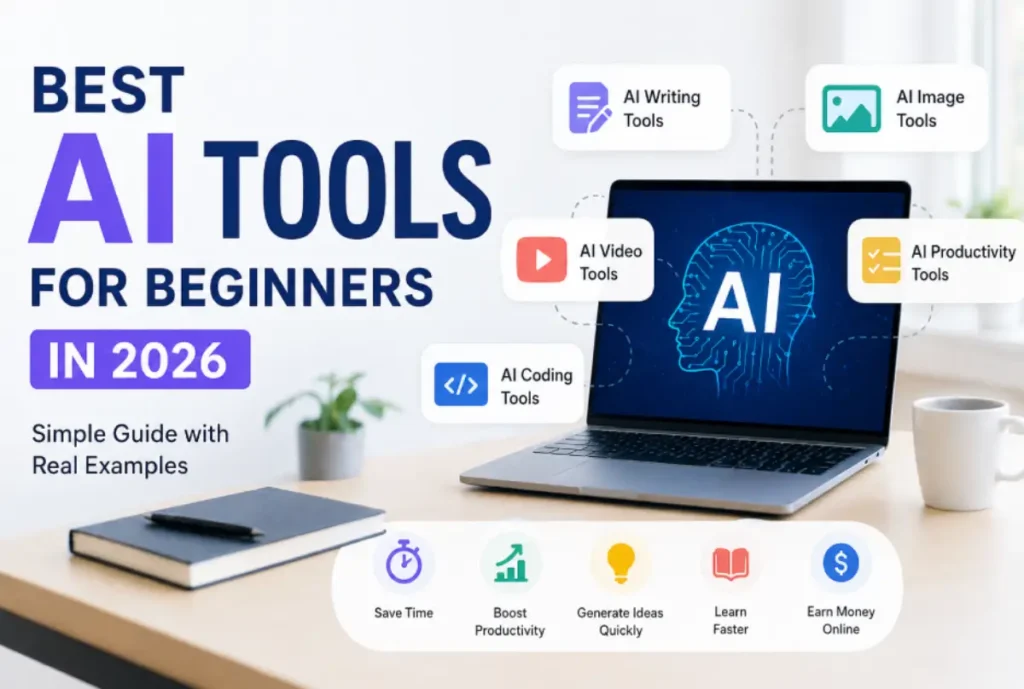
Best AI Tools for Beginners in 2026
Understanding the benefits of Artificial Intelligence is one thing, but choosing the right tool is often where most beginners feel confused. A simple search for AI tools can reveal hundreds of platforms, all promising to save time, improve productivity, and make work easier. For someone just getting started, that number of options can feel overwhelming.
The reality is that not every AI tool is built for beginners. Some platforms are designed for professionals and require advanced knowledge, while others focus on simplicity and ease of use. The good news is that you do not need to learn dozens of tools to experience the benefits of AI.
A much smarter approach is to start with a few beginner-friendly tools that solve real problems in your daily work. Whether your goal is writing content, creating images, editing videos, conducting research, improving productivity, or learning new skills, there is an AI tool designed to make the process easier.
The following tools have become some of the most popular choices in 2026 because they are practical, easy to learn, and capable of delivering real value even for complete beginners.
Quick Comparison of the Best AI Tools for Beginners in 2026
| AI Tool | Best For | Skill Level | Free Version |
|---|---|---|---|
| ChatGPT | Writing, Learning, Brainstorming | Beginner | Yes |
| Google Gemini | Research, Information Gathering | Beginner | Yes |
| DALL·E | AI Image Generation | Beginner | Yes |
| Midjourney | Professional AI Artwork | Intermediate | No |
| Pictory | Video Creation | Beginner | Limited |
| Notion AI | Productivity & Project Management | Beginner | Limited |
| GitHub Copilot | Coding Assistance | Intermediate | Trial Available |
Quick Tip: If you are completely new to Artificial Intelligence, start with ChatGPT or Google Gemini. Both tools are easy to learn, beginner-friendly, and can help with a wide range of everyday tasks such as learning, research, writing, brainstorming, and productivity. Once you become comfortable using them, you can explore more specialized AI tools based on your specific goals.
ChatGPT – The AI Assistant Most Beginners Start With
Among all AI Tools for Beginners, ChatGPT is often considered the easiest platform to start with.
If someone is completely new to Artificial Intelligence, ChatGPT is often the first tool they encounter.
One reason for its popularity is simplicity.
You do not need special training, technical skills, or coding knowledge. You simply type a question, explain a problem, or describe a task, and the AI responds almost instantly.
For many beginners, this feels surprisingly natural. Instead of learning complicated software, they interact with AI the same way they would interact with another person.
A student might ask ChatGPT to explain a difficult topic in simpler language.
A blogger may use it to generate article ideas or create content outlines.
A freelancer can draft emails, proposals, and client communications faster.
Even business owners use it to brainstorm marketing ideas and improve productivity.
The biggest advantage is versatility.
Rather than being built for a single purpose, ChatGPT can assist with writing, learning, planning, research, brainstorming, and problem-solving.
For example, imagine a beginner blogger planning content for the next month. Instead of spending hours thinking about topics, they can ask ChatGPT for article ideas based on their niche. Within minutes, they have a list of potential topics, headline suggestions, and content structures.
Of course, successful creators do not simply copy and paste AI-generated content. They use AI as a starting point and then add their own expertise, experiences, and unique perspective.
If you want a deeper understanding of how this technology works, you can explore “What is ChatGPT and How Does It Work? (Advanced 2026 Guide with Real Examples)“. You may also find “What Happens When You Ask ChatGPT a Question? A Complete Guide“ useful if you are curious about what happens behind the scenes when you enter a prompt.
Google Gemini – An AI Tool Built Around Information and Research
While ChatGPT is widely known for conversations, content creation, and brainstorming, Google Gemini has gained popularity for its strong research and productivity capabilities. It is particularly useful for people who spend a significant amount of time gathering information, learning new topics, or working within Google’s ecosystem.
One reason many beginners find Gemini easy to use is its familiarity. Millions of people already rely on Google Search, Gmail, Google Docs, and other Google services every day. Gemini builds on that existing experience, making the transition into AI-powered tools feel more natural and less intimidating.
Imagine a student working on a school project or a professional researching a new topic. Instead of opening dozens of browser tabs and manually sorting through information, Gemini can help summarize concepts, organize research, and highlight key points more efficiently. This allows users to spend less time searching and more time understanding the information that matters.
Another advantage of Gemini is its ability to work with different types of content. Whether you are reviewing documents, analyzing research material, generating summaries, or brainstorming ideas, the tool can help transform complex information into something easier to understand and use.
For beginners who regularly conduct research, study new subjects, or manage information-heavy tasks, Gemini can become a valuable everyday assistant. Its combination of research capabilities, productivity features, and integration with Google’s services makes it one of the most useful AI Tools for Beginners looking to work smarter and save time.
If you would like to explore Google’s AI ecosystem in greater detail, you can also read “What is Google Gemini AI? Google’s Most Powerful AI Technology.”
DALL·E and Midjourney – Turning Ideas Into Images
Many beginner bloggers struggle to find unique featured images for their articles. Stock photos can often feel repetitive because the same visuals appear on hundreds of different websites. This is where AI image-generation tools have become incredibly useful. By creating custom visuals based on simple text descriptions, these platforms allow creators to produce original images that perfectly match their content. For this reason, image-generation platforms are considered some of the most valuable AI Tools for Beginners who want professional-looking visuals without hiring a designer.
A few years ago, creating high-quality graphics usually required design experience, expensive software, or the help of a professional graphic designer. Today, tools like DALL·E and Midjourney have changed that completely.
Imagine you have just finished writing a detailed article about future technology. The content is ready, but you still need a featured image that captures the idea perfectly. Instead of spending an hour browsing stock photo websites, you can simply describe what you want to see.
For example, you might enter a prompt such as:
“A futuristic city with flying vehicles, smart digital screens, and advanced AI technology.”
Within seconds, the AI can generate multiple unique image options based on that description. This makes content creation faster and gives creators more control over the final visual style.
For bloggers, content creators, marketers, and small business owners, this can save a significant amount of time while also improving the originality of their content. The most interesting part is that creativity becomes more important than technical design skills. You do not need to master complex editing software or spend months learning graphic design principles. Instead, your ability to describe ideas clearly becomes your greatest advantage.
Today, creators use AI image tools for blog featured images, social media graphics, marketing campaigns, presentations, product mockups, and many other creative projects. In most cases, the quality of the final image depends on the quality of the prompt. The more detailed and creative your description is, the better the results tend to be.
If you would like to explore these tools yourself, you can visit the official websites of DALL·E and Midjourney to see how modern AI image generation works in practice.
Pictory – Making Video Creation Easier
Video content continues to dominate platforms like YouTube, Instagram, and TikTok.
For creators who prefer video content, Pictory is one of the most practical AI Tools for Beginners available today.
The challenge is that traditional video editing often requires time, experience, and powerful software.
For beginners, that learning curve can feel intimidating.
This is where tools like Pictory become useful.
Rather than building videos completely from scratch, Pictory helps users transform existing content into videos.
For example, imagine you have written a 1,500-word blog article.
Instead of creating a separate video manually, Pictory can help convert that article into a visual video format.
This is particularly valuable for bloggers and content creators who want to repurpose content across multiple platforms.
A single article can become:
- A YouTube video
- Instagram Reel
- Facebook video
- Short-form content clip
This allows creators to reach different audiences without creating entirely new content every time.
If video creation is important for your content strategy, you may also enjoy reading “Best AI Video Editing Tools | Top AI Video Editor, AI Reel Maker & AI Shorts Maker.“
Notion AI – Your Productivity Partner
While many people associate Artificial Intelligence with content creation, not every AI tool is designed for writing articles or generating images. Some tools focus on something equally important—helping users stay organized, manage their workload, and work more efficiently. This is exactly where Notion AI stands out.
For many beginners, the biggest challenge is not a lack of ideas but keeping those ideas organized. Blog topics get scattered across different notes, client projects are managed in separate applications, content calendars become difficult to track, and important tasks are sometimes forgotten. Over time, this can create unnecessary stress and reduce productivity.
Imagine managing blog ideas, client projects, content calendars, meeting notes, and personal tasks across multiple apps. Switching between different platforms throughout the day can quickly become overwhelming. Notion AI helps solve this problem by bringing everything together in one centralized workspace, making it easier to stay focused and organized.
Whether you are a student managing assignments, a freelancer handling multiple clients, or a blogger planning future content, staying organized is essential for long-term success. Notion AI assists users by summarizing information, organizing notes, planning projects, creating task lists, and streamlining daily workflows. Instead of spending time searching for information, users can keep everything structured and accessible in one place.
Another reason beginners appreciate Notion AI is its simplicity. You do not need advanced technical knowledge to start using it. The platform is designed to help users manage information more efficiently while reducing the clutter that often comes from using multiple productivity tools.
For those looking to improve organization, planning, and productivity, Notion AI has become one of the most useful AI Tools for Beginners available today. Its ability to combine note-taking, project management, and AI-powered assistance within a single workspace is one of the key reasons it continues to grow in popularity.
To learn more about its features and capabilities, you can visit the official Notion AI website. (https://www.notion.so/product/ai)
GitHub Copilot – Learning Coding With AI
Programming can feel overwhelming when you first start learning.
Among coding-focused AI Tools for Beginners, GitHub Copilot stands out because it helps users learn while building projects.
Many beginners spend hours searching for solutions to basic coding problems.
GitHub Copilot aims to make that learning process easier.
Rather than replacing programmers, Copilot acts more like an intelligent coding assistant.
As users write code, the AI suggests improvements, predicts what comes next, and helps solve common problems.
For someone learning programming, this can significantly reduce frustration.
Imagine a beginner creating their first website.
Instead of constantly switching between tutorials and documentation, they receive suggestions directly while coding.
This helps maintain momentum and encourages experimentation.
Of course, beginners should still learn programming fundamentals.
Understanding why code works remains more important than simply accepting AI suggestions.
However, when used correctly, GitHub Copilot can accelerate the learning process and make coding feel less intimidating.
Which AI Tool Should Beginners Start With?
With so many AI tools available today, it is completely normal for beginners to feel confused about where to start. A quick search online can introduce you to dozens of AI platforms, each claiming to be the best solution. As a result, many people spend more time comparing tools than actually learning how to use them.
The truth is that there is no single AI tool that is perfect for everyone. The right choice depends entirely on your goals and the type of work you do on a daily basis.
For example, if your primary focus is content creation, blogging, writing emails, or brainstorming ideas, ChatGPT is often the easiest and most practical starting point. If you frequently conduct research, gather information, or work within Google’s ecosystem, Google Gemini may be a better fit. Those interested in creating unique visuals and graphics can explore DALL·E or Midjourney, while creators focused on video production may find tools like Pictory more valuable. Similarly, people who want to improve organization, note-taking, and productivity often benefit from using Notion AI.
One mistake many beginners make is constantly switching between different platforms without fully understanding any of them. Learning five tools at the same time rarely leads to better results. In fact, it often creates confusion and slows down progress.
A smarter approach is to choose one tool that aligns with your immediate needs and spend time learning its features properly. Once you become comfortable using it in real-world situations, you can gradually explore additional tools and expand your AI toolkit.
Remember, success with AI does not come from using the largest number of tools. It comes from understanding how to use the right tool effectively. The beginners who gain the most value from AI are usually those who start small, practice consistently, and focus on solving real problems rather than chasing every new trend.
Real-Life Examples of Using AI Tools
Reading about AI tools is helpful, but understanding how people use them in real life makes everything much clearer.
One reason AI Tools for Beginners have become so popular is that they solve practical problems. Most users are not interested in the technology behind AI models. They simply want to save time, work smarter, and improve results.
Let’s look at how different people are using AI in their daily lives.
AI Tools for Students
Students are among the biggest beneficiaries of AI technology.
This is why AI Tools for Beginners are becoming increasingly popular among students around the world.
A few years ago, studying often meant spending hours searching through textbooks, websites, and videos to understand a difficult topic. While research is still important, AI tools now make the learning process much faster.
Imagine a student preparing for an exam with limited time.
Instead of reading hundreds of pages repeatedly, they can use AI to summarize key concepts, create study notes, and explain difficult topics in simpler language.
For example, a student struggling with a science concept can ask AI to explain it as if teaching a beginner. The same topic can even be explained using real-life examples, making learning more engaging.
AI can also help students:
- Organize study schedules
- Generate practice questions
- Simplify complex chapters
- Improve writing assignments
- Learn new skills faster
Another practical use case involves career preparation. Students preparing for internships and job applications often struggle to create professional resumes.
In that situation, our guide “Best AI Resume Builder Tools for Freshers: Free ATS-Friendly Resume Builders in 2026“ can help students create resumes that stand out to employers.
The goal is not to let AI do the learning. The goal is to remove unnecessary obstacles so students can focus on understanding concepts more effectively.
AI Tools for Bloggers and Content Creators
Content creation has become more competitive than ever.
Many successful creators now rely on AI Tools for Beginners to speed up their content workflow.
Every day, thousands of articles, videos, social media posts, and newsletters are published online. Standing out requires consistency, creativity, and efficiency.
This is where AI tools provide a significant advantage.
Imagine a blogger who publishes two articles every week.
Before writing even begins, they need topic ideas, keyword research, content outlines, featured images, social media promotion, and sometimes video content.
Managing all these tasks manually can become exhausting.
Many successful creators now use AI to assist with:
- Content brainstorming
- Article outlines
- Headline generation
- Social media captions
- Image creation
- Video repurposing
One important point to remember is that AI works best when combined with human experience.
Readers visit blogs because they want unique insights, personal experiences, and trustworthy information. AI can support content creation, but the personality of the writer remains the most valuable element.
Social media creators are also finding new opportunities through AI-powered tools.
If social media growth is one of your goals, you may find value in reading “AI Tools for Instagram Reels & Social Media Content“, which explores how creators are using AI to improve content production and audience engagement.
AI Tools for Small Businesses
Running a small business often means handling multiple responsibilities at the same time. On any given day, a business owner may need to respond to customer inquiries, create marketing content, manage sales, track finances, and oversee daily operations. The biggest challenge is rarely a lack of ideas—it’s usually a lack of time.
This is one reason why AI has become increasingly valuable for small businesses in recent years. Many AI Tools for Beginners are designed to automate repetitive tasks, allowing business owners to focus on activities that directly contribute to growth. Instead of spending hours writing product descriptions, brainstorming marketing campaigns, or replying to common customer questions, AI can assist with these tasks and significantly reduce the workload.
For example, an online store owner can use AI to create engaging product descriptions, generate social media content, draft promotional emails, and even provide basic customer support responses. Tasks that once required several hours can often be completed in a fraction of the time, helping businesses operate more efficiently.
AI is also being used across a variety of business functions, including customer support automation, content marketing, market research, social media planning, and overall productivity management. What makes 2026 particularly exciting is that tools that were once available only to large corporations are now accessible to small businesses and entrepreneurs at affordable prices.
As AI technology continues to improve, small business owners who learn how to use these tools effectively will have a greater opportunity to save time, reduce costs, and compete more effectively in an increasingly digital marketplace. For many entrepreneurs, AI is no longer just a technology trend—it has become a practical business tool that supports daily operations and long-term growth.
How to Choose the Right AI Tool
One of the most common mistakes beginners make is trying every new AI tool they discover.
At first, this feels productive.
In reality, it often creates confusion.
The better approach is to choose tools based on your specific goals.
Before signing up for any AI platform, ask yourself a few simple questions:
What problem am I trying to solve?
If your goal is writing content, a writing assistant may be the best choice.
If your goal is creating videos, video-focused AI tools make more sense.
Choosing tools based on actual needs prevents unnecessary distractions.
Do I need a free or paid solution?
Most beginners should start with free plans.
Free versions allow users to understand how a tool works before investing money.
Once you see consistent value, upgrading becomes a much easier decision.
How easy is the tool to learn?
Some tools are beginner-friendly.
Others require patience and practice.
Do not choose software simply because it is popular. Choose software that fits your current skill level.
Will I use it regularly?
A powerful AI platform is useless if it sits unused after the first week.
Focus on tools that naturally fit into your daily workflow.
Consistency creates better results than constantly switching between platforms.
Common Mistakes Beginners Make While Using AI Tools
The excitement around AI sometimes causes beginners to develop unrealistic expectations.
Understanding common mistakes can save a lot of frustration.
Copying AI Content Without Editing
This is probably the biggest mistake.
AI-generated content should be viewed as a starting point, not a finished product.
The strongest content combines AI assistance with personal experience, expertise, and human insight.
Using Too Many Tools at Once
Many beginners install five or six AI tools within a few days.
Instead of improving productivity, this often creates confusion.
Learning one tool properly usually delivers better results than using many tools poorly.
Believing AI Is Always Correct
AI can make mistakes.
It can misunderstand prompts.
It can provide outdated or inaccurate information.
Always verify important information before publishing or making decisions.
Ignoring Privacy and Security
Whenever you use AI platforms, be mindful of the information you share.
Avoid uploading sensitive personal or business data without understanding the platform’s privacy policies.
To understand this topic better, consider reading “What Is AI Security? A Complete Guide to AI Threats, Risks, and Protection.“
Can You Earn Money Using AI Tools?
This is one of the most frequently asked questions in 2026.
The short answer is yes.
The realistic answer is that AI helps people earn money by improving productivity rather than generating income automatically.
For example:
Freelancing
Writers, designers, marketers, and virtual assistants often use AI to complete projects more efficiently.
This allows them to handle more clients without sacrificing quality.
Blogging
Bloggers use AI for research, idea generation, content planning, and productivity improvements.
When combined with SEO knowledge and quality content, this can help grow traffic over time.
Social Media Content Creation
AI tools can assist with captions, visuals, video ideas, and content planning.
Creators who publish consistently often benefit from these productivity gains.
Digital Marketing
Marketers use AI to analyze trends, create content, improve campaigns, and streamline workflows.
However, successful digital marketing still depends on strategy and experience.
If this topic interests you, our article “How to earn money using AI Tools? Amazing Tips 2026“ explores practical approaches used by freelancers, bloggers, and entrepreneurs.
Future of AI Tools in 2026 and Beyond
Artificial Intelligence is advancing at a pace that few people could have imagined just a few years ago. The AI tools available today are already helping students learn faster, creators produce content more efficiently, and businesses automate repetitive tasks. However, what we are seeing now is only the beginning.
Over the next few years, AI tools are expected to become more intelligent, more accurate, and far more personalized. Instead of using separate applications for writing, research, design, and productivity, users may soon rely on AI assistants that can handle multiple tasks within a single platform. Voice interactions will become more natural, automation will become smarter, and AI will integrate more deeply into the software people use every day.
One of the most exciting possibilities is the rise of personalized AI assistants. These assistants may learn individual preferences, understand work habits, and provide recommendations that feel increasingly tailored to each user. For students, this could mean customized learning support. For businesses, it could lead to more efficient workflows and better decision-making. For content creators, it may simplify everything from idea generation to content distribution.
Of course, whenever new technology becomes more powerful, questions about jobs and the future of work naturally follow. Many people wonder whether AI will eventually replace human workers. The reality is more complex than a simple yes or no answer. Throughout history, technology has transformed industries by automating certain tasks while also creating entirely new opportunities. Artificial Intelligence appears to be following a similar path.
While some routine activities may become automated, skills such as creativity, critical thinking, communication, and problem-solving will continue to hold significant value. Those who learn how to work alongside AI rather than compete against it are likely to have a strong advantage in the years ahead.
If you are curious about how AI may impact careers and employment opportunities in the future, be sure to read our article, “Will AI Replace Human Jobs? | AI Jobs Future”, where we explore this topic in greater detail.
Conclusion
A few years ago, many people believed Artificial Intelligence was something only programmers and technology experts could use. Today, that idea has changed completely. From students and bloggers to freelancers and business owners, AI has become a practical tool that helps ordinary people work more efficiently and achieve better results.
The most important thing to remember is that success with AI does not come from using every tool available. It comes from choosing the right tool for your needs and learning how to use it effectively. Whether your goal is writing better content, creating engaging videos, improving organization, or learning new skills, there are many AI tools for beginners that can make the process easier and more efficient.
For most people, starting with platforms like ChatGPT, Google Gemini, or Notion AI is more than enough to experience the real benefits of Artificial Intelligence. As your confidence grows, you can gradually explore other beginner-friendly AI tools that match your interests and goals.
At the end of the day, AI is not a replacement for human creativity, critical thinking, or experience. The people who achieve the best results are those who combine technology with their own ideas, knowledge, and unique perspective.
If you are completely new to AI, start with one tool, use it consistently for a few weeks, and focus on solving real problems rather than chasing every new trend. Small daily improvements often create the biggest long-term results. opportunities in the digital world.
Frequently Asked Questions (FAQs)
What are the best AI tools for beginners in 2026?
The best AI tools for beginners in 2026 include ChatGPT for writing and learning, Google Gemini for research, Notion AI for productivity, Pictory for video creation, DALL·E for image generation, and GitHub Copilot for coding assistance. The right tool depends on your goals and workflow.
Are AI tools free to use?
Many AI tools offer free plans with limited features. Beginners can start with free versions before deciding whether a paid subscription is necessary.
Which AI tool is best for students?
Students often benefit from ChatGPT, Google Gemini, and Notion AI because these tools help with learning, note-taking, research, and organization.
Can AI tools help me earn money online?
Yes. AI tools can support freelancing, blogging, content creation, digital marketing, and online businesses by improving productivity and efficiency.
Is ChatGPT better than Google Gemini?
Both tools have strengths. ChatGPT is popular for conversations and content creation, while Google Gemini is often preferred for research and information-related tasks.
Do I need technical skills to use AI tools?
Modern AI Tools for Beginners are designed for ordinary users who want practical solutions without technical complexity.