Table of Contents
Introduction
Artificial Intelligence (AI) is transforming how people work, learn, communicate, shop, and access information. From virtual assistants and recommendation systems to advanced healthcare solutions and business automation, AI has become one of the most influential technologies of the modern era.
Just a few years ago, AI was primarily discussed in technology conferences, research laboratories, and science fiction movies. Today, it has become an essential part of everyday life for millions of people worldwide.
Whether you are searching for information on Google, asking ChatGPT a question, using Google Gemini for research, watching recommended videos on YouTube, shopping on Amazon, or scrolling through social media, Artificial Intelligence is working behind the scenes. Many people interact with AI every day without even realizing it.
The rapid growth of AI has transformed how businesses operate, how students learn, how healthcare professionals diagnose diseases, and how content creators produce digital content. In 2026, AI is no longer viewed as a futuristic concept. It is a practical technology that helps individuals and organizations save time, improve productivity, and solve complex problems more efficiently.
For example, when Netflix recommends a movie based on your viewing history, AI analyzes your preferences. When Google Maps suggests the fastest route to your destination, AI processes real-time traffic data. When ChatGPT generates a response to your question, advanced AI models analyze patterns learned from vast amounts of information to provide relevant answers.
As AI continues to evolve, understanding what Artificial Intelligence is, how it works, where it is used, and what its future may look like has become increasingly important. Whether you are a student, business owner, professional, or technology enthusiast, learning about AI can help you better understand one of the most transformative technologies shaping the future.
What is Artificial Intelligence?
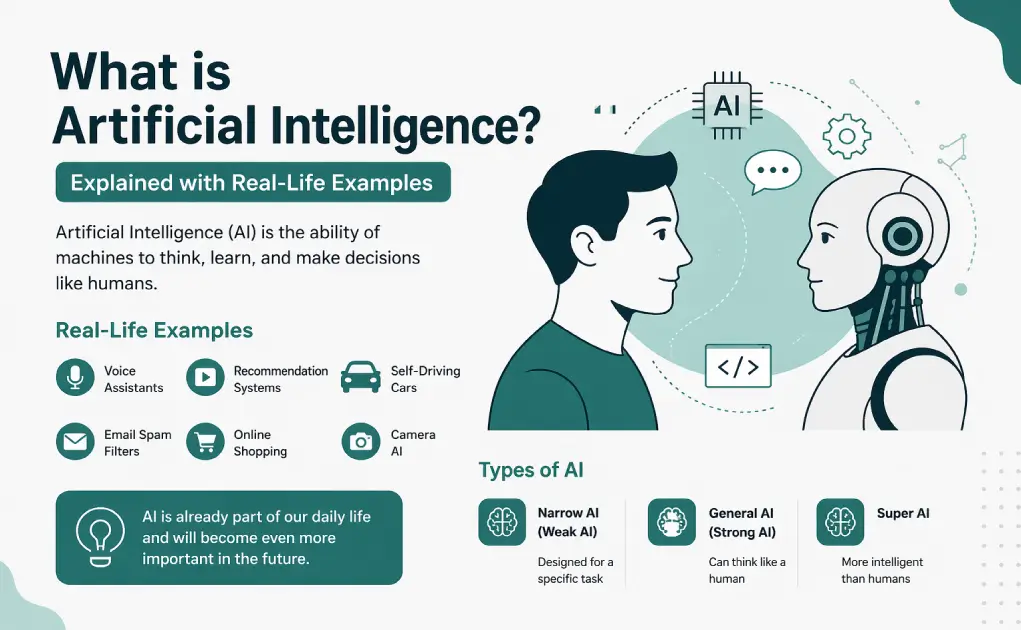
Artificial Intelligence (AI) is a branch of computer science that focuses on creating machines and software capable of performing tasks that normally require human intelligence.
Human intelligence involves learning from experience, understanding language, solving problems, recognizing patterns, making decisions, and adapting to new situations. AI attempts to replicate some of these abilities using data, algorithms, and computing power.
Unlike traditional software that follows fixed instructions, AI systems can learn from data and improve their performance over time. This ability to learn and adapt is what makes AI different from conventional computer programs.
A simple way to understand AI is to think of it as technology that enables machines to make intelligent decisions based on available information.
For example, a traditional calculator will only perform calculations that you explicitly ask it to perform. An AI-powered financial assistant, however, can analyze spending habits, identify patterns, predict future expenses, and provide personalized recommendations.
AI is not a single technology. It is a combination of multiple technologies including machine learning, deep learning, natural language processing, computer vision, and neural networks.
AI vs Traditional Software
Traditional software operates according to predefined rules created by programmers.
| Traditional Software | Artificial Intelligence (AI) |
|---|---|
| Follows predefined rules | Learns from data and experience |
| Requires manual programming for every task | Can identify patterns and improve performance over time |
| Produces the same output for the same input | Can adapt responses based on new data |
| Limited flexibility | Highly flexible and adaptive |
| Requires frequent manual updates | Continuously improves through learning models |
| Works best in predictable situations | Can handle complex and dynamic environments |
| Makes decisions based on fixed logic | Makes predictions and decisions based on data analysis |
The key difference between traditional software and Artificial Intelligence is the ability to learn from data. Traditional software follows fixed instructions created by programmers, while AI systems can analyze information, recognize patterns, and improve their performance over time. This makes AI more adaptable and effective for solving complex real-world problems.
For example:
If temperature > 30°C → Turn on AC
The software follows the rule exactly as written.
AI systems work differently.
Instead of following only fixed rules, AI learns from data. It identifies patterns and develops the ability to make predictions based on previous experiences.
For instance, a traditional spam filter might block emails containing specific keywords. An AI-powered spam filter can learn from millions of emails and identify spam even when the wording changes.
This ability to learn makes AI more flexible and powerful than traditional software.
History of Artificial Intelligence
The idea of intelligent machines is not new. Scientists have been exploring the concept for decades.
The journey began in the 1950s when British mathematician Alan Turing introduced the question, “Can machines think?” His work laid the foundation for modern AI research.
In 1956, a group of researchers gathered at Dartmouth College in the United States. This event became known as the Dartmouth Conference and is widely considered the birth of Artificial Intelligence as an academic field.
During the following decades, researchers made significant progress. However, limitations in computing power and data slowed development. These periods of reduced funding and interest became known as AI Winters.
Everything changed with the growth of the internet, cloud computing, and big data. Modern computers became powerful enough to process enormous amounts of information.
The launch of advanced AI systems such as ChatGPT, Gemini, Claude, and Copilot sparked a new wave of innovation known as the AI Boom.
Today, AI is one of the fastest-growing industries in the world.
How AI Actually Works
At its core, AI works by analyzing large amounts of data and identifying patterns.
The process typically begins with data collection.
Data can include text, images, videos, audio recordings, customer behavior, medical records, or any other form of information.
Once the data is collected, algorithms process it. Algorithms are sets of instructions that help computers analyze information and find meaningful patterns.
Machine Learning allows AI systems to learn from this data. Instead of being manually programmed for every situation, the system discovers patterns on its own.
For example, if an AI model is shown millions of pictures of cats and dogs, it gradually learns the visual differences between them.
Deep Learning takes this concept further by using neural networks inspired by the structure of the human brain.
To better understand how modern AI assistants generate responses, you can also explore our detailed guide on how AI chatbots work and how conversational AI systems process user queries.
These neural networks contain multiple layers that process information and improve prediction accuracy.
Real-Life Example
Imagine that you regularly watch cricket highlights on YouTube.
The platform records:
- Videos you watch
- Watch time
- Likes
- Comments
- Search history
AI analyzes these signals and predicts which videos you are most likely to watch next.
This is why two people often see completely different recommendations on the same platform.
Types of Artificial Intelligence
Narrow AI (Weak AI)
Narrow AI is designed to perform specific tasks.
Examples include:
- Siri
- Alexa
- Google Assistant
- Netflix recommendations
- Google Maps navigation
Although highly effective, Narrow AI cannot perform tasks outside its specialized area.
Current Status:
This is the only form of AI widely used today.
General AI (Strong AI)
General AI refers to a machine capable of performing any intellectual task that a human can perform.
Such a system would understand concepts, reason independently, learn across multiple domains, and adapt to new situations.
Current Status:
General AI does not yet exist and remains a research goal.
Super AI
Super AI is a theoretical future form of intelligence that surpasses human capabilities in every field.
A Super AI system could potentially:
- Solve complex scientific problems
- Discover new technologies
- Make advanced strategic decisions
- Learn significantly faster than humans
Current Status:
Super AI remains a hypothetical concept and has not been achieved.

Real-Life Applications of Artificial Intelligence
Artificial Intelligence is no longer limited to research laboratories or technology companies. Today, AI is deeply integrated into everyday life, often working in the background without users even realizing it.
From healthcare and education to transportation and cybersecurity, AI is helping organizations improve efficiency, reduce costs, and provide better services.
AI in Healthcare
Healthcare is one of the industries experiencing the biggest transformation due to Artificial Intelligence.
Doctors and hospitals generate massive amounts of data every day, including patient records, medical scans, laboratory reports, and treatment histories. AI helps medical professionals analyze this information more quickly and accurately.
For example, AI-powered systems can examine X-rays, CT scans, and MRI images to identify abnormalities that might be difficult to detect with the human eye alone.
Several healthcare organizations now use AI to assist in the early detection of diseases such as cancer, diabetes, and heart conditions.
AI is also accelerating drug discovery. Traditionally, developing a new medicine can take many years and cost billions of dollars. AI models can analyze large datasets and identify promising drug candidates much faster than traditional methods.
Virtual healthcare assistants are another growing application. These systems can answer common medical questions, schedule appointments, remind patients to take medications, and provide basic health guidance.
While AI cannot replace qualified healthcare professionals, it serves as a powerful tool that supports faster diagnosis, improved treatment planning, and better patient care.
AI in Education
Education has changed significantly with the adoption of Artificial Intelligence.
Traditional education often follows a one-size-fits-all approach, where every student receives the same material regardless of their learning speed or strengths.
AI-powered learning platforms can personalize education based on individual needs.
For example, a student preparing for exams can use AI tools to generate practice questions, summarize lengthy chapters, and receive instant explanations for difficult concepts. This personalized support can make learning faster and more effective.
Modern AI tutors can answer questions, explain concepts, generate quizzes, and provide instant feedback.
Many students now use AI-powered tools to summarize notes, improve writing skills, learn programming, practice languages, and prepare for examinations. Tools such as ChatGPT, Gemini, and other AI learning assistants are making education more personalized and accessible.
The future of education is likely to become increasingly personalized, making learning more effective and accessible worldwide.
AI in Banking and Finance
Financial institutions process millions of transactions every day.
Detecting fraud manually would be almost impossible.
AI systems continuously monitor transaction patterns and can instantly identify unusual activities.
For example, if a customer normally makes purchases in India but suddenly attempts multiple transactions from another country, AI can flag the activity for investigation.
Banks also use AI-powered chatbots to handle customer service inquiries, reducing waiting times and improving customer experiences.
Investment firms increasingly rely on AI for market analysis and risk assessment.
By processing enormous amounts of financial data, AI can help analysts identify trends and make more informed decisions.
AI in E-Commerce
Online shopping platforms use AI extensively.
When you browse products on Amazon, Flipkart, or other marketplaces, AI analyzes your behavior to recommend products that match your interests.
These recommendations are based on:
- Search history
- Purchase history
- Product views
- Shopping preferences
AI-powered chatbots assist customers with product questions and support requests.
Inventory management systems use AI to predict demand and optimize stock levels.
This helps businesses reduce waste while ensuring popular products remain available.
AI in Transportation
Transportation is becoming smarter because of AI.
Navigation apps such as Google Maps use AI to analyze traffic conditions and recommend the fastest routes.
These systems process data from millions of users in real time.
Self-driving vehicle technology represents one of the most advanced applications of AI.
Autonomous vehicles rely on:
- Cameras
- Sensors
- GPS
- Machine learning models
to understand their surroundings and make driving decisions.
Although fully autonomous transportation is still developing, AI is already improving road safety and traffic management.
AI in Cyber Security
Cyber threats continue to increase as businesses become more dependent on digital systems.
Traditional security methods often struggle to detect sophisticated attacks.
AI-powered cybersecurity systems can analyze network activity continuously and identify suspicious behavior.
For example, if a hacker attempts to access sensitive systems using unusual login patterns, AI can detect the anomaly and trigger security alerts.
AI-powered cybersecurity systems help organizations detect threats faster, identify unusual network activity, and respond to attacks before significant damage occurs.
AI is helping security teams respond faster to threats while reducing the workload associated with manual monitoring.
Advantages of Artificial Intelligence
Artificial Intelligence offers many benefits, but understanding why these advantages matter is more important than simply listing them.
Increased Productivity
One of the greatest strengths of AI is its ability to automate repetitive tasks.
Employees often spend significant time on activities such as data entry, scheduling, report generation, and information processing.
AI can complete many of these tasks in seconds.
This allows people to focus on more valuable work requiring creativity, critical thinking, and decision-making.
For businesses, improved productivity often translates into increased efficiency and profitability.
Improved Accuracy
Humans can make mistakes due to fatigue, distractions, or incomplete information.
AI systems can process enormous amounts of data consistently and accurately.
In fields such as healthcare, finance, and engineering, improved accuracy can have a significant impact on outcomes.
For example, AI-assisted medical imaging systems can help doctors identify potential problems more quickly and reduce diagnostic errors.
Automation
Automation is one of the most visible benefits of AI.
Many routine tasks that previously required manual effort can now be automated.
Examples include:
- Customer support
- Data analysis
- Content categorization
- Inventory management
- Email filtering
Automation saves time while improving consistency.
Cost Reduction
Although implementing AI solutions may require investment, long-term operational costs can often be reduced.
Businesses can streamline workflows, improve resource utilization, and increase efficiency.
As AI technology becomes more accessible, even small businesses can benefit from automation and intelligent decision-making tools.
Disadvantages of Artificial Intelligence
Despite its advantages, AI also presents several challenges that organizations and governments must address.
Privacy Risks
AI systems require large amounts of data to function effectively.
This data may include personal information, behavioral patterns, and user preferences.
Improper data handling can create privacy concerns.
Companies must implement strong security measures and transparent policies to protect user information.
Job Displacement
Automation has the potential to replace certain repetitive jobs.
While AI creates new opportunities, some traditional roles may decline.
Workers may need to develop new skills to remain competitive in an increasingly technology-driven economy.
The topic can be explored further through your article “Will AI Replace Human Jobs?“
Bias and Fairness Issues
AI systems learn from data.
If training data contains biases, AI models may produce unfair outcomes.
For example, biased datasets can affect hiring systems, loan approvals, or recommendation algorithms.
Developers must continuously evaluate and improve AI systems to reduce these risks.
Security Risks
AI can be used for beneficial purposes, but it can also be misused.
Cybercriminals may use AI to:
- Create phishing campaigns
- Generate fake content
- Automate attacks
- Produce deepfake videos
This is why responsible AI development and strong cybersecurity measures are becoming increasingly important.
Future of Artificial Intelligence
Artificial Intelligence is still in its early stages compared to what experts believe it could become in the coming decades. While AI is already helping people write content, generate images, analyze data, and automate tasks, future AI systems are expected to be far more capable, intelligent, and integrated into everyday life.
The future of AI will not be limited to chatbots or recommendation systems. It is likely to transform transportation, healthcare, education, business operations, scientific research, and even how people interact with technology on a daily basis.
AI Agents: The Next Evolution of Artificial Intelligence
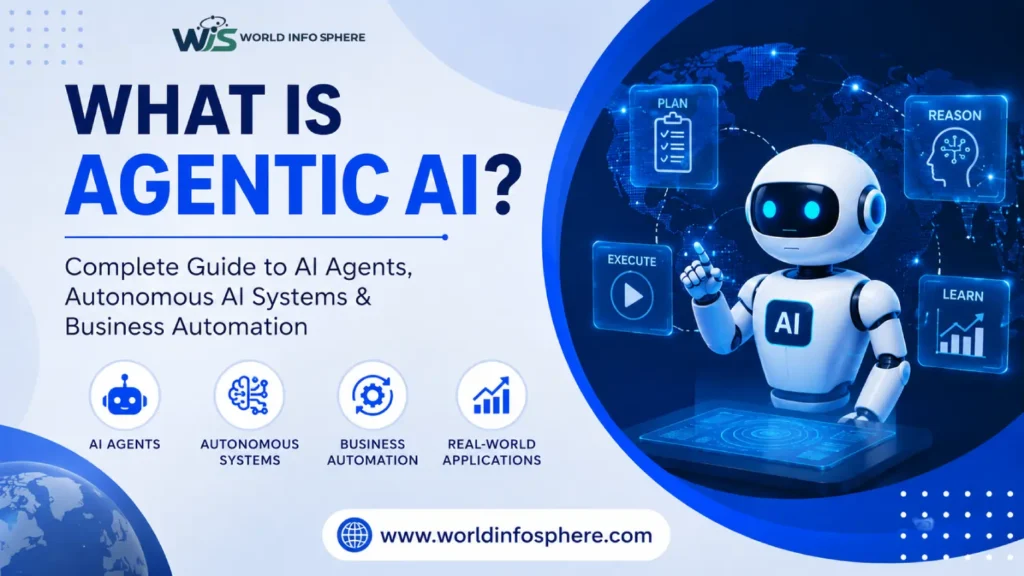
An AI Agent will be able to understand goals, plan actions, make decisions, and complete multi-step tasks with minimal human involvement.
For example, imagine telling an AI agent:
“Plan my 5-day business trip to Mumbai.”
Instead of simply providing suggestions, the AI agent could:
• Research and compare flight options
• Find suitable hotels based on budget and preferences
• Create a complete travel itinerary
• Schedule meetings and appointments
• Add events directly to your calendar
• Send reminders and important travel updates
All of these tasks could be completed automatically with minimal human input.
Similarly, a small business owner could ask an AI agent to analyze customer feedback, create a marketing report, schedule follow-up tasks, and send reminders automatically. Instead of handling one task at a time, future AI agents may be capable of managing entire workflows, helping businesses save time and improve efficiency.
Modern AI assistants such as ChatGPT, Gemini, and Claude rely on advanced language models to understand user queries and generate relevant responses. While these tools are highly capable of answering questions, generating content, and assisting with tasks, future AI Agents are expected to go much further by planning actions, making decisions, and completing complex workflows autonomously. Understanding how AI chatbots work can provide valuable insight into the technology behind today’s most popular AI-powered tools and the next generation of intelligent AI systems.
Autonomous Vehicles and Intelligent Transportation
Transportation is expected to become one of the biggest beneficiaries of Artificial Intelligence.
Current navigation systems already use AI to analyze traffic conditions and suggest the fastest routes. However, future transportation systems may operate with minimal human intervention.
Self-driving vehicles use cameras, sensors, radar systems, machine learning algorithms, and real-time data processing to understand their surroundings.
Future AI-powered transportation may include:
- Self-driving cars
- Autonomous trucks
- Smart public transportation
- AI-powered delivery robots
- Drone delivery systems
Imagine a city where vehicles communicate with each other and traffic signals in real time. AI could optimize traffic flow, reduce congestion, lower fuel consumption, and improve road safety.
Human error causes many traffic accidents worldwide. Since AI systems do not get distracted, tired, or emotionally affected, advanced autonomous systems could potentially reduce accident rates significantly.
Although fully autonomous transportation still faces technical and regulatory challenges, major technology and automotive companies continue investing heavily in this area.
AI in Business Automation
Businesses generate enormous amounts of data every day.
Processing this information manually can be expensive, time-consuming, and inefficient.
Future AI systems will increasingly automate business operations across industries.
Many organizations already use AI for:
- Customer support
- Marketing campaigns
- Sales forecasting
- Inventory management
- Data analysis
- Employee assistance
In the future, AI may become a digital co-worker capable of handling routine tasks independently.
For example, an AI system could:
Analyze customer behavior, identify sales opportunities, generate marketing campaigns, track performance, create reports, and recommend improvements automatically.
Small businesses may benefit significantly from these technologies because AI can help them compete with larger organizations while operating with fewer resources.
Learn more about how AI is transforming small businesses and helping entrepreneurs improve productivity and growth.
Future AI systems may also support entrepreneurs by helping with content creation, market research, customer engagement, and business planning.
Robotics and Smart Machines
Robotics combined with Artificial Intelligence has the potential to reshape multiple industries.
Traditional robots follow predefined instructions. AI-powered robots, however, can adapt to changing environments and make decisions based on real-time information.
Future smart robots may become common in:
Manufacturing
Factories may use AI-powered robots to assemble products, inspect quality, and manage production lines with greater efficiency.
Warehousing and Logistics
Companies may deploy intelligent robots to sort packages, organize inventory, and optimize delivery operations.
Agriculture
Farmers may use AI-powered machines to:
- Monitor crop health
- Detect plant diseases
- Predict harvest yields
- Optimize irrigation systems
This could improve food production while reducing waste.
Healthcare
Medical robots may assist surgeons during complex procedures, improving precision and reducing recovery times.
Home Assistance
Future home robots could help with cleaning, security monitoring, elderly care, and household management.
Although science fiction often portrays robots replacing humans entirely, the more realistic scenario involves humans and intelligent machines working together.
AI and Human Collaboration
One of the biggest misconceptions about Artificial Intelligence is that it will completely replace humans.
In reality, the most likely future involves collaboration rather than replacement.
AI excels at:
- Processing large datasets
- Identifying patterns
- Automating repetitive tasks
- Generating insights
Humans excel at:
- Creativity
- Emotional intelligence
- Strategic thinking
- Leadership
- Ethical judgment
The future workplace is likely to combine the strengths of both.
For example:
A content creator may use AI to generate research outlines while personally adding expertise, storytelling, and unique insights.
A doctor may use AI to analyze medical scans while making the final diagnosis and treatment decisions.
A business owner may use AI-generated reports while deciding overall company strategy.
This partnership between humans and AI could significantly improve productivity and innovation.
Read our detailed guide on whether AI will replace human jobs and how the future workforce may evolve.
Artificial General Intelligence (AGI)
One of the most discussed topics in AI research is Artificial General Intelligence, commonly known as AGI.
Current AI systems are examples of Narrow AI.
They perform specific tasks extremely well but lack general understanding.
For example:
ChatGPT can generate text but cannot physically interact with the world.
Image generators can create artwork but cannot independently manage complex real-world tasks.
AGI represents a future AI system capable of performing any intellectual task that a human can perform.
An AGI system could potentially:
- Learn new skills independently
- Understand complex concepts
- Transfer knowledge between domains
- Solve unfamiliar problems
- Adapt to changing environments
Researchers and technology companies continue exploring AGI, but experts disagree on when—or even whether—it will be achieved.
Some believe AGI could emerge within decades, while others think it remains a distant goal.
If achieved, AGI would represent one of the most significant technological breakthroughs in human history.
AI Regulations, Ethics, and Responsible Development
As AI becomes more powerful, concerns about safety, privacy, fairness, and accountability continue to grow.
Governments, researchers, and technology companies are increasingly focusing on responsible AI development.
Several challenges require careful attention:
Privacy Protection
AI systems often process large amounts of user data.
Organizations must ensure that personal information is handled securely and ethically.
Bias and Fairness
AI models learn from historical data.
If training data contains bias, AI systems may produce unfair outcomes.
Developers must continuously test and improve AI models to reduce discrimination and improve fairness.
Deepfakes and Misinformation
AI can generate highly realistic images, videos, and audio recordings.
While these technologies have positive applications, they can also be misused to spread misinformation.
Transparency
Users should understand when they are interacting with AI systems and how decisions are being made.
Accountability
Clear rules must determine who is responsible when AI systems make mistakes or cause harm.
Many countries are already developing AI regulations to address these concerns.
Future AI development will likely involve a balance between innovation, safety, privacy, and ethical responsibility.
Explore our complete AI Security guide to understand AI-related threats, risks, and protection strategies.
Final Thoughts on the Future of AI
The future of Artificial Intelligence is expected to be far more advanced than the technologies we use today.
AI Agents, autonomous vehicles, intelligent robotics, business automation systems, and future AGI research could transform industries and everyday life in ways that are difficult to fully predict.
However, the most important factor is not whether AI becomes more powerful—it is how humans choose to use it.
Organizations, governments, developers, and users all have a role to play in ensuring that AI remains beneficial, ethical, and aligned with human values.
The future will likely belong not to humans alone or AI alone, but to those who learn how to work effectively alongside intelligent technologies.
Related Article:
What is Google Gemini AI? Google’s most powerful AI technology
Best AI Resume Builder Tools for Freshers: Free ATS-Friendly Resume Builders in 2026
Top Free AI Tools You Must Use in 2026 for Productivity
Frequently Asked Questions
Is AI dangerous?
AI itself is not inherently dangerous. However, improper use of AI can create risks such as misinformation, privacy concerns, and cybersecurity threats.
Can AI replace human jobs?
AI can automate certain repetitive and routine tasks, but it is also creating new opportunities in technology and digital industries.
Is ChatGPT an example of AI?
Yes. ChatGPT is a generative AI system developed by OpenAI that uses advanced language models to understand questions and generate human-like responses.
What is the difference between AI and Machine Learning?
Artificial Intelligence (AI) is the broader field of creating intelligent systems, while Machine Learning (ML) is a subset of AI that enables systems to learn from data and improve performance without being explicitly programmed for every task.
Which industries use AI the most?
AI is widely used in healthcare, finance, education, transportation, e-commerce, cybersecurity, manufacturing, and customer service. Its applications continue to expand across nearly every industry.
Is AI the future?
Yes. AI is expected to play a major role in future technological advancements by improving automation, productivity, decision-making, healthcare, education, and business operations.
Can AI think like humans?
No. Current AI can simulate certain aspects of human intelligence, such as language understanding and pattern recognition, but it does not possess human consciousness, emotions, or true reasoning abilities.
What is Generative AI?
Generative AI is a type of artificial intelligence that creates new content such as text, images, audio, videos, and code by learning patterns from large datasets.
How does ChatGPT generate answers?
ChatGPT analyzes patterns learned from vast amounts of text data and predicts the most relevant response based on the user’s input. It does not search the internet for every answer unless specifically connected to web-search capabilities.
Is Google Gemini an AI tool?
Yes. Google Gemini is Google’s advanced AI assistant and language model designed to help users with research, content creation, coding, problem-solving, and productivity tasks.
Conclusion
Whether you realize it or not, Artificial Intelligence is already influencing many aspects of your daily life—from the videos you watch and the routes you travel to the products you buy online and the content you consume.
From virtual assistants and recommendation systems to advanced healthcare solutions and business automation, AI is transforming the way people live, work, learn, and communicate.
As AI technology continues to evolve, it will create new opportunities across industries while also introducing challenges related to privacy, security, and responsible use. Understanding how AI works, where it is used, and what its future may look like can help individuals and businesses make smarter decisions in an increasingly digital world.
Those who learn to understand and work alongside AI will be better prepared to benefit from the opportunities this powerful technology will create in the years ahead.