Table of Contents
Artificial Intelligence is no longer something we only hear about in tech news or science fiction movies. It has quietly become a part of our everyday life. Whether you are unlocking your phone with face recognition, watching videos on YouTube, using Google Maps to find directions, or even chatting with tools like ChatGPT — AI is already working behind the scenes. But here’s something most people still don’t clearly understand: AI is not just one single technology. It doesn’t work in the same way everywhere. In fact, AI is divided into different types based on how “intelligent” and capable it is.
Some AI systems are very simple and designed to do one specific job really well. Some are much more advanced and try to behave more like humans. And some are still only ideas that scientists are working toward for the future.
That’s why understanding the types of Artificial Intelligence is so important today. Because once you understand this, you stop seeing AI as just a tool — and start seeing it as something that is slowly shaping the way we live, work, learn, and even think.
In this guide, we are going to break everything down in a very simple and human way. No heavy technical language, no confusing terms — just clear explanations with real-life examples you can actually relate to.
You will learn what AI really is, how it works in daily life, and most importantly, how it is divided into three main types: Narrow AI, General AI, and Super AI. Along the way, you will also see how each type is already affecting your life without you even noticing it.
By the end of this article, AI will not feel like a complicated concept anymore. It will feel like something familiar — something you interact with every single day.
Introduction to Artificial Intelligence Types
As Artificial Intelligence continues to evolve, understanding the Types of Artificial Intelligence has become more important than ever. Not all AI systems work in the same way or possess the same level of intelligence. Some AI systems are designed to perform specific tasks, while others aim to replicate human-like thinking and decision-making abilities. By learning about the different Types of Artificial Intelligence, readers can better understand how modern AI technologies operate, where they are used in daily life, and what the future of intelligent machines may look like.
When people first hear the term Artificial Intelligence, they often imagine robots or futuristic machines taking over human jobs. But in reality, AI is much more subtle and already deeply embedded in the systems we use every day.
What makes AI even more interesting is that it doesn’t exist in just one form. It behaves differently depending on how it is designed and what it is meant to do. Some AI systems are very narrow and focused on one specific task, while others aim to be far more intelligent and flexible.
To understand AI properly, it’s important to stop thinking of it as a single technology and start seeing it as a range of intelligence levels. This is exactly why experts divide AI into different types.
Why Understanding AI Types Matters in Real Life
Most people use AI every single day without realizing it. When Spotify suggests a song you end up loving, or when Instagram shows you reels that match your interests, that is AI learning from your behavior.
But here is the real question — do you know what kind of AI is doing that?
Understanding AI types is not just for students or developers. It actually helps in real-life decisions:
- If you are a student, it helps you understand how tools like ChatGPT or Gemini assist in learning
- If you are a content creator, it helps you understand how platforms like YouTube or Instagram push your content
- If you are a business owner, it helps you understand how AI can increase sales and automate work
- If you are someone exploring tech careers, it helps you understand future job opportunities
In short, knowing AI types helps you stop using technology blindly and start using it intelligently.
And this is even more important in 2026, because AI is not slowing down — it is growing faster than ever.
How AI is Classified in 2026
AI is classified based on one simple idea: how close it is to human intelligence.
Some systems are very basic and only follow instructions for a single task. Others can learn from data and improve over time. And a few are still theoretical ideas that scientists are trying to build for the future.
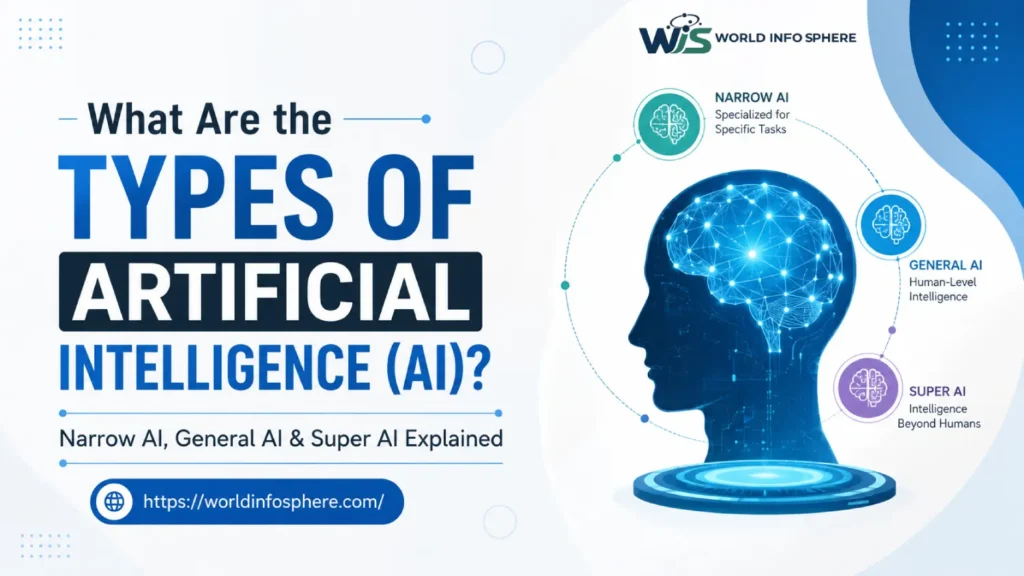
Based on this intelligence level, AI is generally divided into three main categories:
- Narrow AI (Weak AI) — focused on one task, like Google Maps or voice assistants
- General AI (Strong AI) — machines that could think and learn like humans (not fully built yet)
- Super AI (Artificial Superintelligence) — a future concept where AI could be smarter than humans in every possible way
Each of these types represents a different stage in the journey of artificial intelligence.
What is Artificial Intelligence?
Artificial Intelligence (AI) sounds like a very technical term, but in reality, it is something you already interact with many times a day without even noticing.
In simple words, AI is a technology that allows machines and software to act in a way that feels “intelligent” — meaning they can learn from data, understand patterns, and make decisions without being manually programmed for every single situation.
But unlike humans, AI does not think or feel. It doesn’t have emotions or consciousness. Instead, it works based on data, patterns, and probability. It learns from what it has seen before and tries to predict what might happen next.
That’s why AI feels smart — because it keeps improving as it processes more information.
Simple Definition of Artificial Intelligence
Artificial Intelligence is a technology that enables machines to perform tasks that normally require human intelligence, such as learning, problem-solving, understanding language, and making decisions.
But the important thing to understand is this:
- AI is not “thinking” like humans
- It is “calculating and predicting” based on data
How AI Works in Real Life (With Simple Examples)
AI becomes much easier to understand when we connect it to real life.
Let’s take a few examples you probably see every day:
YouTube Recommendations
When you watch a few cricket videos on YouTube, the platform starts showing you more sports-related content.
This is not random — AI is studying your behavior and predicting what you will like next.
Google Maps Navigation
When you search for a route, Google Maps doesn’t just show one path. It analyzes traffic, road conditions, and travel history to suggest the fastest possible route.
Spotify or Music Apps
When a song matches your taste, AI notices your listening habits and creates playlists that feel “perfectly made for you”.
ChatGPT Conversations
When you ask a question, AI reads millions of patterns from training data and generates a response that feels natural and human-like.
If you want to understand this deeper, you can read: What is ChatGPT and How Does It Work? (Advanced 2026 Guide with Real Examples)
A Simple Real-Life Way to Understand AI
Think of AI like a very fast learner who watches your behavior silently.
- It notices what you like
- It remembers patterns
- It predicts what you might do next
But it doesn’t “understand” you like a human friend. It just calculates probabilities based on data.
That’s why sometimes AI recommendations feel perfect… and sometimes they feel completely wrong.
Why AI Feels So Powerful in 2026
In 2026, AI has become extremely powerful because of three main reasons:
- A massive amount of data is available online
- Faster computers and cloud systems
- Advanced machine learning algorithms
Because of this, AI is now used in almost every industry:
- Healthcare for disease detection
- Education for personalized learning
- Business for automation and analytics
- Social media for content recommendations
If you want to explore how AI is used in business growth, you can also read: How to earn money using AI Tools? Amazing Tips 2026
Types of Artificial Intelligence
Now that you understand what Artificial Intelligence actually means, it becomes much easier to explore how it is divided into different types.
AI is not the same everywhere. Some systems are very simple and limited to one task, while others are far more advanced in theory and aim to think like humans in the future.

To make this easier to understand, AI is mainly divided into three important types:
- Narrow AI (Weak AI)
- General AI (Strong AI)
- Super AI (Artificial Superintelligence)
Each type represents a different level of intelligence and capability.
Let’s understand them one by one in a very simple and real-life way.
1. Narrow AI (Weak AI)
Narrow AI is the most common type of Artificial Intelligence we use in our daily lives.
It is designed to do one specific task really well, but it cannot go beyond that task.
What is Narrow AI?
Narrow AI is an AI system that is built to perform a specific function, such as voice recognition, recommendation systems, navigation, or chat-based responses.
It may look smart, but its intelligence is limited to the area it is trained for.
Real-Life Examples of Narrow AI
You are already using Narrow AI every day without realizing it:
- Google Maps suggests the fastest route
- YouTube recommends videos you might like
- Netflix is showing personalized movies
- Instagram feed algorithm
- Siri, Alexa, Google Assistant
- ChatGPT answering questions
For example, when Netflix suggests a movie that matches your taste, it is not “understanding your feelings” — it is analyzing your past behavior and predicting what you might enjoy.
Limitations of Narrow AI
Even though Narrow AI is very useful, it has clear limitations:
- It cannot think beyond its training data
- It cannot perform multiple unrelated tasks
- It does not understand emotions
- It cannot learn like a human in real-time situations
For example, Google Maps can guide you, but it cannot cook food or write a story.
If you want to understand how AI systems respond to users in detail, you can read: What Happens When You Ask ChatGPT a Question? A Complete Guide
2. General AI (Strong AI)
General AI is the type of Artificial Intelligence that most people imagine when they think about “human-like machines”.
But the truth is — it does not exist yet.
What is General AI?
General AI refers to a system that can understand, learn, and apply intelligence across any type of task, just like a human being.
It would not be limited to one job or one area — it would be able to switch between tasks, learn new skills, and solve unfamiliar problems.
Characteristics of General AI
If General AI becomes real, it would:
- Learn new things without retraining
- Understand different types of problems
- Think and reason like humans
- Adapt to new environments easily
Current Status of General AI (2026)
As of 2026, General AI is still not developed.
Even advanced tools like ChatGPT or Google Gemini are still examples of Narrow AI, not General AI.
If you want to explore current AI systems, read: What is Google Gemini AI? Google’s most powerful AI technology
Challenges in Building General AI
Creating General AI is extremely difficult because:
Understanding Human Intelligence: We still don’t fully understand how the human brain processes thoughts, decisions, and creativity.
Emotional Understanding: Humans make decisions based on emotions, experience, and context — something AI cannot truly replicate.
Self-Awareness Problem: General AI would need to understand itself, which is still a theoretical concept.
Ethical Concerns: If AI becomes too intelligent, questions arise about control, safety, and decision-making power.
3. Super AI (Artificial Superintelligence)
Super AI is the most advanced and theoretical form of Artificial Intelligence. It is still only an idea — not something that exists today.
What is Super AI?
Super AI refers to a system that is not just equal to human intelligence, but far beyond it in every possible way. It would be able to outperform humans in science, creativity, decision-making, and problem-solving.
Possible Capabilities of Super AI
In theory, Super AI could:
- Solve complex global problems
- Make scientific discoveries faster than humans
- Improve itself continuously
- Predict outcomes with extreme accuracy
Risks and Concerns of Super AI
While it sounds powerful, Super AI also raises serious concerns:
- Loss of human control
- Ethical and safety risks
- Misuse of extremely powerful intelligence
- Unpredictable behavior
Is Super AI Possible?
Right now, Super AI is only a concept discussed by scientists and researchers. It does not exist in reality. But it remains one of the most debated topics in the future of technology.
Comparison of AI Types (Table + Easy Understanding)
Now that you have understood Narrow AI, General AI, and Super AI separately, let’s make things even simpler. Sometimes reading definitions is not enough. Our brain understands things better when we compare them side by side.
So in this table, we will break down all three types of AI in a very simple comparison so you can clearly see how they are different in real life.
Narrow AI vs General AI vs Super AI
| Feature | Narrow AI (Weak AI) | General AI (Strong AI) | Super AI (Artificial Superintelligence) |
|---|---|---|---|
| Intelligence Level | Task-specific intelligence | Human-level intelligence | Beyond human intelligence |
| Current Status | Available today | Under research | Theoretical concept |
| Learning Ability | Limited to trained tasks | Can learn across domains | Self-improving continuously |
| Problem Solving | Specific problems only | Broad problem solving | Superior problem solving |
| Adaptability | Limited | Human-like adaptability | Extremely adaptable |
| Self-Awareness | No | Potentially | Potentially advanced |
| Examples | ChatGPT, Siri, Google Maps | Not achieved yet | Does not exist |
| Real-World Usage | Common today | Future possibility | Hypothetical future |
Simple Human Understanding
Let’s make this even easier.
Think about it like three levels of intelligence:
Narrow AI = A Skilled Worker
It is very good at one job, like:
- A driver who only drives
- A chef who only cooks
It does that job perfectly, but cannot do other things.
General AI = A Human Brain (Future Idea)
It would be like a person who can:
- Learn cooking
- Drive a car
- Solve math problems
- Write stories
All with the same intelligence system.
But this level of AI is not built yet.
Super AI = Beyond Human Intelligence (Concept)
This is the most advanced idea.
It would be like:
- A mind smarter than all humans combined
- Able to solve problems we cannot even understand yet
But right now, it only exists in theory.
Real-Life Connection
If you want to understand how these AI systems actually respond to you in real time, you can read: What Happens When You Ask ChatGPT a Question? A Complete Guide
And if you are curious about modern AI assistants, this will also help: What is Google Gemini AI? Google’s most powerful AI technology
Real-Life Applications of AI Types (Deep Practical Examples in Daily Life)
Artificial Intelligence might sound like a complex technical concept, but the truth is — you are already surrounded by it every single day.
From the moment you wake up and unlock your phone to the time you scroll social media at night, AI is constantly working in the background. Most of the time, you don’t even realize it.
But what makes it even more interesting is that different types of AI are used in different areas of life. Some are simple and practical, while others are shaping the future of entire industries.
Let’s understand how Narrow AI, General AI (future), and Super AI (theoretical) are connected to real-life situations.
AI in Healthcare (Saving Lives with Technology)
Healthcare is one of the most important areas where AI is making a real impact.
Today, doctors don’t rely only on experience or manual observation. AI systems help them analyze medical data faster and more accurately.
How Narrow AI is used in healthcare:
- Detecting diseases from X-rays and MRI scans
- Predicting patient risk based on medical history
- Suggesting treatment plans
- Monitoring heart rate and health data from smart devices
For example, AI can help detect early signs of diseases like cancer much faster than traditional methods.
But still, it is important to remember that AI does not replace doctors — it only assists them.
AI in Education (Personal Learning Experience)
Education has changed completely in the last few years.
Students no longer depend only on textbooks and classrooms. AI tools now help them learn in a more personalized and interactive way.
Real uses of AI in education:
- AI tutors that explain difficult topics
- Smart apps that create quizzes and practice tests
- Language learning assistants
- Automatic summarization of notes
If a student struggles with math but is good at science, AI can adjust learning content accordingly.
You can also explore: Best AI Resume Builder Tools for Freshers: Free ATS-Friendly Resume Builders in 2026
AI in Business and Marketing (Behind Every Online Ad You See)
Every time you see an ad on Instagram or Google, AI is involved.
Businesses today rely heavily on AI to understand customer behavior and improve sales.
How AI is used in business:
- Predicting customer behavior
- Personalized product recommendations
- Automated customer support chatbots
- Marketing campaign optimization
For example, when you search for shoes online and later see shoe ads everywhere — that’s AI tracking patterns and interests.
AI in Transportation (Smarter Travel Every Day)
Transportation is becoming faster and smarter because of AI.
Real-world AI applications:
- Google Maps suggests the fastest routes
- Traffic prediction systems
- Ride-sharing apps like Uber match drivers and passengers
- Early development of self-driving cars
AI helps reduce travel time by analyzing real-time traffic conditions and making instant decisions.
AI in Cybersecurity (Protecting the Digital World)
As everything goes online, security has become very important.
AI plays a major role in protecting systems from cyberattacks.
AI in cybersecurity:
- Detecting suspicious login attempts
- Identifying unusual network activity
- Blocking spam and phishing emails
- Preventing fraud in banking systems
For example, if someone tries to log in from a different country, AI systems can immediately flag it as suspicious.
Related reading: What Is AI Security? A Complete Guide to AI Threats, Risks, and Protection
AI in Social Media and Entertainment
Social media platforms are powered almost entirely by AI.
How AI works here:
- Instagram feed personalization
- YouTube video recommendations
- TikTok/short video suggestions
- Music and movie recommendations
AI studies your behavior — what you like, what you skip, and what you watch repeatedly — and then builds your personalized content feed.
Advantages of Artificial Intelligence (Real Benefits in Daily Life + Business Impact)
Artificial Intelligence is often discussed as a future technology, but in reality, its benefits are already shaping the present. From small daily tasks to large business operations, AI is helping people save time, reduce effort, and make better decisions.
What makes AI powerful is not just its ability to perform tasks but the way it improves speed, accuracy, and efficiency in everything it touches.
Let’s understand the real advantages of Artificial Intelligence simply and practically.
Increased Productivity in Daily Life and Work
One of the biggest advantages of AI is how much time it saves.
Many tasks that used to take hours can now be completed in minutes.
Real-life examples:
- Writing emails or content using AI tools
- Automating data entry in businesses
- Scheduling meetings automatically
- Getting instant answers from AI assistants
For example, a business employee who spends 2–3 hours daily preparing reports can now use AI tools to generate summaries in a few seconds.
This doesn’t just save time — it completely changes how work is done.
Related reading: How to earn money using AI Tools? Amazing Tips 2026
Better Accuracy and Fewer Human Errors
Humans can make mistakes — especially when working with large amounts of data or repetitive tasks.
AI systems, on the other hand, can process information consistently without getting tired or distracted.
Examples:
- AI detecting errors in financial reports
- Medical systems are identifying diseases more accurately
- Spell-check and grammar correction tools
- Fraud detection in banking systems
In healthcare, even a small improvement in accuracy can save lives. That is where AI becomes extremely valuable.
Automation of Repetitive Tasks
Many jobs involve repetitive tasks that do not require creativity or deep thinking.
AI is very good at handling these tasks.
Common automated tasks:
- Customer support chat replies
- Email filtering and spam detection
- Social media posting schedules
- Inventory management in online stores
For example, an online business can use AI chatbots to handle customer queries 24/7 without human involvement.
This allows humans to focus on more meaningful work instead of routine tasks.
Cost Reduction for Businesses
AI may look like an expensive technology, but in the long run, it actually helps businesses reduce costs.
How AI saves money:
- Reducing the need for large human teams for repetitive work
- Improving efficiency in production systems
- Reducing errors that cause financial loss
- Optimizing marketing and advertising budgets
For example, instead of hiring multiple support agents, a company can use AI chatbots to handle thousands of customer queries at the same time.
Faster Decision Making
In today’s fast-moving world, decision-making speed is very important.
AI can analyze large amounts of data in seconds and provide insights that help humans make better decisions.
Examples:
- Stock market prediction tools
- Business performance analysis dashboards
- Customer behavior analysis in marketing
- Route optimization in logistics
A business owner can quickly understand which product is performing better and adjust the strategy instantly.
Personalized User Experience
One of the most visible advantages of AI is personalization.
AI learns from user behavior and creates a customized experience for each individual.
Examples:
- YouTube recommends videos you actually enjoy
- Netflix suggests movies based on your taste
- Online shopping websites show relevant products
- Spotify is creating personalized playlists
This makes technology feel more “human-like” and relevant to each person.
24/7 Availability Without Fatigue
Unlike humans, AI systems never get tired.
They can work continuously without breaks, sleep, or downtime.
Real-world impact:
- Customer support chatbots work all day and night
- Automated systems monitoring security 24/7
- Online services respond instantly anytime
This is especially useful for global businesses that operate across different time zones.
Simple Human Understanding
If we look at all these advantages together, one thing becomes clear:
AI is not replacing humans — it is removing limitations
It helps us:
- Work faster
- Make fewer mistakes
- Save time
- Focus on creative and meaningful tasks
But at the same time, it also changes how industries and jobs work.
Limitations of Artificial Intelligence (Real Challenges, Risks & Human Impact)
Even though Artificial Intelligence has become extremely powerful and useful in today’s world, it is not perfect. Like every technology, AI also comes with its own limitations and challenges.
Understanding these limitations is very important because it helps us use AI in a smarter and more responsible way instead of depending on it blindly.
Let’s look at the real-world problems and risks of AI simply and practically.
Data Dependency (AI Depends Completely on Data)
One of the biggest limitations of AI is that it completely depends on data to work.
If the data is incomplete, outdated, or biased, then AI results will also be wrong.
Real example:
If an AI system is trained mostly on old customer behavior data, it may fail to understand new trends or changes in user preferences.
In simple words: AI is only as smart as the data it learns from.
Job Displacement and Work Changes
AI is automating many tasks that were previously done by humans.
While this increases efficiency, it also creates concerns about job loss in certain industries.
Examples:
- Customer support roles replaced by chatbots
- Data entry work is automated by software
- Basic content generation handled by AI tools
But the reality is not fully negative — new jobs are also being created in AI development, automation, and data analysis.
Still, people need to upgrade their skills to stay relevant in the future job market.
Related reading: Will AI Replace Human Jobs? | AI Jobs Future
Bias and Fairness Issues
AI systems learn from human-generated data. And because humans can have biases, AI can also unintentionally learn and repeat those biases.
Example:
If an AI hiring system is trained on biased historical data, it may unfairly prefer certain candidates over others.
This is one of the biggest ethical concerns in Artificial Intelligence today.
Developers must constantly monitor and improve AI systems to ensure fairness.
Security and Misuse Risks
AI is a powerful tool, but in the wrong hands, it can also be misused.
Possible risks:
- Creating fake images or videos (deepfakes)
- Automated cyber attacks
- Phishing emails that look very real
- Manipulation of online information
This is why AI security is becoming extremely important in 2026.
Related reading: What Is AI Security? A Complete Guide to AI Threats, Risks, and Protection
Lack of Human Emotions and Understanding
Even though AI can process data very fast, it still does not understand human emotions.
Example:
An AI chatbot can answer “I’m feeling sad” with supportive words, but it does not actually feel empathy or understand emotional depth as a human does.
This makes AI powerful in logic, but weak in emotional intelligence.
Over-Reliance on Technology
Another hidden problem is that people are becoming too dependent on AI.
Real-life situation:
- Students using AI to write entire assignments
- Businesses depending fully on automation
- People relying on AI for decision-making
While AI is helpful, over-dependence can reduce human creativity and critical thinking over time.
Simple Human Understanding
If we look at all these limitations together, one thing becomes clear:
- AI is powerful, but not perfect
- It still needs human guidance, supervision, and control
Think of AI like a very fast assistant — but not a replacement for human thinking.
Future of Artificial Intelligence (AI Agents, Growth & What Comes Next)
If we look at how fast Artificial Intelligence has grown in just a few years, it almost feels like we are watching the beginning of something much bigger than we fully understand.
What started as simple automation tools has now turned into systems that can write, design, analyze, and even talk like humans. But what we are seeing today is still only the beginning.
The future of Artificial Intelligence is not just about better tools — it is about completely changing how humans and machines work together.
AI Agents — The Next Big Shift
One of the most important changes coming in AI is the rise of AI Agents.
Today, most AI tools work simply — you ask a question, and they give you an answer. But future AI Agents will work very differently.
Instead of just responding, they will be able to think, plan, and take action to complete full tasks.
Example in real life:
Imagine you say:
“Plan my business trip for next week.”
Instead of just giving suggestions, an AI Agent could:
- Search for the best flights
- Book hotels based on your budget
- Schedule meetings automatically
- Create a full travel plan
- Send reminders before departure
It will feel less like a tool and more like a digital assistant that actually works for you.
If you want to understand current AI systems better, read: What is ChatGPT and How Does It Work? (Advanced 2026 Guide with Real Examples)
Rapid Growth of AI in Every Industry
AI is not growing in one area — it is expanding across every major industry at the same time.
Healthcare
AI will help doctors detect diseases earlier and design personalized treatments.
Education
Students will get fully personalized learning experiences based on their speed and understanding.
Business
Companies will use AI to run marketing, customer support, and even decision-making processes.
Transportation
Self-driving systems and smart traffic management will become more common.
If you want to explore AI in business, read: How to earn money using AI Tools? Amazing Tips 2026
AI Becoming a Daily Life Partner
In the future, AI will not feel like a separate technology.
It will feel like a part of daily life — just like smartphones today.
You might not even notice when you are interacting with AI, because it will be everywhere:
- in your home devices
- in your car navigation
- in your social media feed
- in your work tools
AI will quietly assist you in almost everything you do.
Challenges in the Future of AI
Even though the future of AI looks exciting, it also brings important challenges.
1. Control and Safety
As AI becomes more powerful, controlling it responsibly will be very important.
2. Ethical Decisions
If AI starts making decisions, who is responsible when something goes wrong?
3. Job Transformation
Many jobs will change, and people will need to learn new skills.
Related reading: Will AI Replace Human Jobs? | AI Jobs Future
4. Over-Dependence
Humans may start relying too much on AI and reduce their own thinking ability.
What Comes Next After AI Today?
Right now, we are in the era of Narrow AI — tools that perform specific tasks.
But the future will move step by step:
- Better Narrow AI (smarter tools)
- Semi-autonomous AI systems
- AI Agents that complete full tasks
- Early stages of General AI (future research)
- Possibly Super AI (long-term concept)
Each step will make AI more independent and more powerful.
Simple Human Understanding
If we look at the bigger picture, AI is not just a technology trend.
It is becoming a new layer of intelligence around human life.
But the most important truth is:
- AI will not replace humans completely
- Instead, humans who use AI will replace those who don’t
Frequently Asked Questions (FAQ)
What are the main types of Artificial Intelligence?
he main types are Narrow AI, General AI, and Super AI.
Which type of AI is used in real life today?
Narrow AI is widely used in real-life applications like Google Maps, YouTube, and ChatGPT.
Is ChatGPT an example of Artificial Intelligence?
Yes, ChatGPT is an example of Narrow AI based on machine learning and language models.
What is the difference between AI and Machine Learning?
AI is the broader concept of smart machines, while Machine Learning is a method used to build AI systems.
What is the future of Artificial Intelligence?
AI will become more advanced with AI Agents, automation, and human-like digital assistance in daily life.
Why is Narrow AI called Weak AI?
Narrow AI is called Weak AI because it is designed to perform specific tasks only. It cannot think, reason, or learn beyond its trained purpose like humans can.
Does General AI exist today?
No. General AI does not currently exist. Researchers and technology companies are actively working toward developing AI systems capable of human-level intelligence, but this goal has not yet been achieved.
Is ChatGPT Narrow AI or General AI?
ChatGPT is an example of Narrow AI. Although it can generate human-like responses, it is designed for language-related tasks and does not possess human-level intelligence or self-awareness.
What is the difference between Narrow AI and General AI?
Narrow AI performs specific tasks within a limited domain, while General AI would be capable of understanding, learning, and performing virtually any intellectual task that a human can perform.
Can Super AI become dangerous?
Some researchers believe Super AI could create risks if it becomes more intelligent than humans without proper safety controls. However, Super AI remains a theoretical concept and does not currently exist.
Which type of AI is most commonly used today?
Narrow AI is the most widely used type of Artificial Intelligence today. Examples include ChatGPT, Google Maps, Netflix recommendations, Siri, Alexa, and search engines.
Conclusion
Artificial Intelligence is not a single technology but a spectrum of intelligence levels ranging from Narrow AI to the future concepts of General AI and Super AI.
Today, Narrow AI powers many of the digital tools people use every day, including virtual assistants, recommendation systems, navigation apps, chatbots, and search engines. While General AI and Super AI remain theoretical goals, ongoing research continues to push the boundaries of what intelligent systems can achieve.
Understanding the different types of Artificial Intelligence helps students, professionals, businesses, and technology enthusiasts better understand how modern AI works and where future innovations may lead.
As AI continues to evolve, staying informed about its capabilities, limitations, and real-world applications will become increasingly important. Those who understand AI today will be better prepared to adapt, innovate, and succeed in an increasingly AI-driven world.
If used correctly, AI is not a threat — it is a powerful tool that can help humans achieve more than ever before.