Table of Contents
Introduction
The first time I seriously used an AI tool, I wasn’t trying to understand artificial intelligence. I was simply looking for a faster way to complete a task. What surprised me wasn’t how quickly AI generated an answer—it was how confident that answer sounded, even when parts of it weren’t completely accurate.
That experience made me curious. If AI can write, answer questions, analyze information, and even generate images, how close is it to human intelligence? More importantly, are we comparing two things that work in completely different ways?
Over the last year, I’ve spent a lot of time exploring AI tools, reading expert opinions, testing different platforms, and observing how people use AI in everyday life. The more I learned, the more I realized that the debate around AI vs Human Intelligence is often oversimplified.
Many people assume that faster means smarter. Others believe human intelligence can never be matched by a machine. Based on my research and experience, the reality sits somewhere between those two extremes.
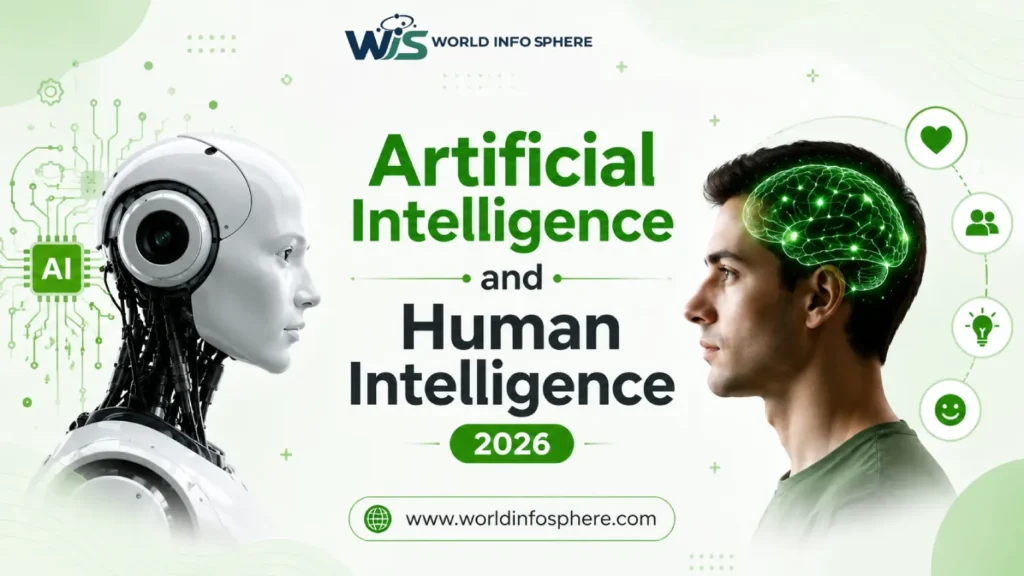
When comparing Artificial Intelligence and Human Intelligence, it’s important to understand that both have unique strengths and limitations. AI excels at processing data and recognizing patterns, while humans bring creativity, emotions, intuition, and real-world experience to the table.
In this article, I’ll break down the real differences between Artificial Intelligence and Human Intelligence, explore where each has advantages, discuss their limitations, and share why I believe the future is more likely to be about collaboration than competition rather than a battle of AI vs Human Intelligence.
What Is AI and Human Intelligence?
Before comparing AI and human intelligence, it helps to understand what each one actually means. At first glance, they may seem similar because both can learn, solve problems, process information, and help make decisions. However, the way they work is completely different.
Artificial Intelligence is built by humans and trained using large amounts of data. It learns by identifying patterns, analyzing information, and following algorithms designed to perform specific tasks. Human intelligence, on the other hand, develops naturally over time through experiences, emotions, education, relationships, successes, mistakes, and everyday life.
One thing I’ve noticed while using AI tools is that they’re incredibly good at finding patterns and delivering answers quickly. But intelligence is about much more than speed or access to information. Human intelligence includes qualities like creativity, common sense, emotional awareness, intuition, and the ability to understand context in a way that machines still struggle with.
That’s what makes the comparison between AI vs Human Intelligence so interesting. Both are capable of impressive things, but they approach learning, thinking, and problem-solving from completely different perspectives. Understanding those differences is the first step toward understanding where AI excels, where humans still have the advantage, and how both are likely to work together in the future.
What Is Artificial Intelligence (AI)?
When I first started using AI tools, I assumed they were simply advanced search engines. The more I explored them, the more I realized that Artificial Intelligence is much more than that.
In simple terms, Artificial Intelligence (AI) is technology designed to perform tasks that typically require human intelligence. These tasks can include understanding language, recognizing images, analyzing data, solving problems, generating content, and even making predictions based on available information.
What makes modern AI so powerful is its ability to learn from data. Instead of following a fixed set of instructions, many AI systems improve over time by identifying patterns and processing massive amounts of information. This is where technologies like machine learning and deep learning play an important role.
Today, AI is everywhere, even if most people don’t notice it. Every time Netflix recommends a movie, Spotify suggests a playlist, Google predicts a search query, or ChatGPT answers a question, Artificial Intelligence is working behind the scenes.
Some of the most common applications of AI include:
- AI chatbots and virtual assistants
- Search engines and recommendation systems
- Video editing and content creation tools
- Social media automation platforms
- Fraud detection and cybersecurity systems
- Healthcare diagnostics and medical research
- Customer support automation
One thing I’ve noticed while testing different AI tools is that they’re incredibly good at finding patterns and processing information quickly. However, that doesn’t mean they truly understand what they’re doing. AI doesn’t think, feel, or experience the world the way humans do.
Instead, it analyzes data, identifies patterns, and generates responses based on what it has learned during training. That’s an important distinction because it’s also one of the biggest differences between Artificial Intelligence and Human Intelligence.
What Is Human Intelligence?
The more I researched the difference between AI and humans, the more I realized that human intelligence is incredibly difficult to define with a simple explanation. Most people think intelligence is about knowledge, memory, or problem-solving, but in reality, it goes much deeper than that.
Human Intelligence is the ability to learn from experiences, understand emotions, adapt to changing situations, communicate with others, and make decisions based on both logic and personal judgment. Unlike Artificial Intelligence, which relies on data and algorithms, humans are influenced by their experiences, relationships, successes, failures, beliefs, and emotions.
Think about an important decision you’ve made in your life. Chances are you didn’t rely only on facts. You probably considered your past experiences, your instincts, the people involved, and how the outcome might affect your future. That’s something humans do naturally. We connect information with emotions, context, and real-world experiences in a way that machines still struggle to replicate.
Another thing that makes Human Intelligence unique is the ability to learn from very limited information. A person can make a mistake once and remember that lesson for years. AI systems, on the other hand, often require massive amounts of data and repeated training before they can improve their performance. This is one of the key differences discussed in our guide on What is Artificial Intelligence? (Complete Beginner Guide 2026).
Human Intelligence also includes qualities such as creativity, critical thinking, emotional awareness, ethical reasoning, and adaptability. These abilities help people solve complex problems, build relationships, lead teams, and create new ideas that go beyond existing patterns or data. In fact, many of these uniquely human qualities are at the center of the debate explored in Will AI Replace Human Jobs? | AI Jobs Future.
This is why, despite the rapid growth of Artificial Intelligence, Human Intelligence remains one of the most powerful and unique capabilities in the world. It’s not just about what we know—it’s about how we understand, interpret, and respond to the world around us.
How AI and Human Intelligence Work Differently
This is where things start to get really interesting.
Many people compare AI and Human Intelligence as if they work in the same way. On the surface, that seems true. Both can solve problems, answer questions, learn new information, and make decisions. But the process behind those actions is completely different.
AI learns from data. The more information it receives, the better it becomes at identifying patterns and generating responses. Human Intelligence doesn’t work like that. We learn from experiences, conversations, mistakes, emotions, and everyday situations. Sometimes a single experience can teach a person more than thousands of examples ever could.
Think about how a child learns. A child might see a dog a few times and immediately understand what a dog is. An AI system may need thousands of images before it can reliably recognize the same thing. That’s because humans don’t just memorize information—we connect it to memories, context, and real-world experiences.
Another important difference is understanding. AI can provide answers that sound intelligent, but it doesn’t actually understand the world the way people do. It doesn’t have personal experiences, emotions, beliefs, or life lessons influencing its decisions. Humans naturally use all of those things when making choices or solving problems.
That’s why AI can be incredibly powerful in areas like data analysis and automation, while humans continue to have an advantage in creativity, leadership, emotional intelligence, and complex decision-making. The more I learn about AI, the more I realize that comparing AI and Human Intelligence isn’t really about deciding which is smarter. It’s about understanding that they operate in completely different ways.
Difference Between AI and Human Intelligence
The comparison between artificial intelligence and human intelligence goes far beyond determining which one is more powerful. Each possesses unique strengths and limitations that make them suitable for different types of tasks.
While AI excels at processing large amounts of data quickly and accurately, human intelligence remains unmatched in areas involving creativity, emotions, ethics, and complex judgment.
The following comparison highlights some of the most important differences between AI and human intelligence.
AI vs Human Intelligence Comparison Table
| Feature | Artificial Intelligence (AI) | Human Intelligence |
|---|---|---|
| Learning Method | Learns from data and algorithms | Learns from experiences and observation |
| Creativity | Generates content based on patterns | Creates original ideas and innovations |
| Emotional Intelligence | Simulates emotions but does not feel them | Understands and experiences emotions |
| Decision Making | Data-driven and analytical | Combines logic, intuition, and emotions |
| Speed | Extremely fast processing | Relatively slower processing |
| Adaptability | Limited to training and programming | Highly adaptable to new situations |
| Memory | Stores large amounts of information accurately | Selective and experience-based memory |
| Problem Solving | Excels in structured tasks | Excels in complex and uncertain situations |
Learning and Adaptation
One of the biggest differences between AI and human intelligence is the way learning occurs.
AI systems learn by analyzing massive datasets and identifying patterns within that information. The more relevant data available, the better the AI system can perform.
Humans, however, can often learn from a single experience. A mistake, a conversation, or a personal challenge can significantly influence future decisions and behavior.
Human learning is dynamic and flexible, allowing individuals to adapt quickly to unfamiliar situations. AI typically performs best within the environments and tasks it was specifically trained to handle.
Creativity and Innovation
Creativity remains one of the most fascinating aspects of the AI versus human intelligence debate.
AI can create articles, images, music, videos, and even software code. Many modern tools discussed in our guide on Best AI Video Editing Tools | Top AI Video Editor, AI Reel Maker & AI Shorts Maker demonstrate how advanced AI-generated content has become.
However, AI creativity is largely based on existing patterns and training data.
Human creativity often emerges from imagination, emotions, personal experiences, curiosity, and unique perspectives. The ability to invent entirely new concepts, challenge existing ideas, and create groundbreaking innovations continues to be a uniquely human strength.
Emotional Intelligence
One of the biggest advantages humans have over AI is emotional intelligence. People can understand emotions, read social cues, build relationships, and respond differently depending on the situation. These abilities influence everything from communication and leadership to teamwork and personal relationships.
AI can recognize emotional language and generate responses that sound supportive, but it doesn’t actually experience emotions. It can identify signs of happiness, sadness, or frustration in text, yet it has never felt any of those emotions itself. That’s why genuine empathy and emotional understanding remain uniquely human qualities.
Decision-Making Ability
AI and humans make decisions in very different ways. AI relies on data, probabilities, and pattern recognition to identify the most likely outcome. This makes it extremely effective for tasks such as fraud detection, predictive analytics, and data-driven recommendations.
Humans, however, often consider factors that go beyond data. Experience, ethics, intuition, emotions, and personal judgment all play a role in important decisions. This ability to evaluate situations from multiple perspectives allows people to navigate uncertainty and make choices in complex real-world scenarios.
Speed and Accuracy
When it comes to processing information, Artificial Intelligence has a clear advantage. AI systems can analyze massive datasets, identify trends, and generate results within seconds. Tasks that might take humans hours or days can often be completed almost instantly by AI.
However, speed isn’t everything. While humans generally process information more slowly, they often bring deeper understanding and critical thinking to the process. In many situations, the best outcomes come from combining AI’s speed with human judgment and expertise.
Memory and Information Processing
AI can store and retrieve enormous amounts of information with impressive accuracy. Unlike humans, it doesn’t forget details because of stress, distractions, or time. This makes AI particularly useful for tasks that require handling large volumes of data.
Human memory works differently. Rather than simply storing facts, people connect information with experiences, emotions, and context. This ability helps humans understand meaning, learn from past experiences, and make more informed decisions in situations where context matters as much as information itself.
AI vs Human Intelligence in Learning and Problem Solving
Learning and problem-solving are two of the most important indicators of intelligence. Both AI and humans can solve problems, but the way they learn and arrive at solutions is very different. AI relies heavily on data and patterns, while humans combine knowledge with experience, intuition, and reasoning. Understanding these differences helps explain why AI excels in some tasks while humans remain superior in others.
How AI Learns from Data
Artificial Intelligence learns by analyzing large amounts of data and identifying patterns within it. The more relevant data an AI system receives, the better it becomes at making predictions and completing tasks. For example, an AI chatbot improves its responses by learning from countless conversations and language patterns. Unlike humans, AI does not understand information in a personal or emotional way. Instead, it relies on mathematical models and statistical probabilities to generate outputs and recommendations.
How Humans Learn from Experience
Humans learn through a combination of education, observation, emotions, and real-life experiences. A single event can teach a person a lesson that influences decisions for years. Unlike AI, humans can adapt quickly to unfamiliar situations without requiring thousands of examples. Personal experiences often shape judgment, creativity, and problem-solving abilities. This ability to learn from both success and failure gives human intelligence a depth that machines currently cannot replicate.
AI vs Human Intelligence in Complex Problem Solving
AI is highly effective at solving structured problems where clear patterns and data exist. It can analyze vast amounts of information in seconds and identify solutions that might take humans much longer to discover. However, complex real-world problems often involve uncertainty, emotions, ethics, and incomplete information. In such situations, humans are better equipped to evaluate context and make balanced decisions. This is why AI is often most powerful when it supports human decision-making rather than replacing it entirely.
AI vs Human Intelligence in Creativity
Creativity is one of the most fascinating areas in the comparison between AI and human intelligence. Modern AI tools can generate articles, images, videos, music, and even software code. However, creativity is not simply about producing content—it is about creating something meaningful, original, and inspired by unique experiences. This distinction is what continues to separate machine-generated outputs from true human creativity.
Can AI Be Creative?
AI can certainly produce creative-looking results. Today, businesses and content creators use AI tools to write blogs, generate images, create videos, and develop marketing campaigns. For example, many creators use AI-powered platforms featured in our guide on Best AI Video Editing Tools | Top AI Video Editor, AI Reel Maker & AI Shorts Maker to speed up content production. However, AI generates content by analyzing patterns from existing data rather than experiencing inspiration or imagination. Its creativity is based on prediction rather than genuine originality.
Why Human Creativity Remains Unique
Human creativity is influenced by emotions, memories, culture, personal struggles, and life experiences. A writer may create a powerful story inspired by childhood memories, while an entrepreneur may develop a unique business idea based on years of experience. These deeply personal influences cannot be replicated by algorithms. Human creativity often emerges from curiosity, passion, and the desire to express ideas that have never existed before. This ability to create something truly original remains one of humanity’s strongest advantages.
AI-Generated Art and Content
AI-generated art and content have improved dramatically in recent years. AI can now create realistic images, marketing copy, social media posts, videos, and even music compositions within seconds. These tools can save time and increase productivity for businesses and creators. However, AI-generated content still depends on existing information and patterns. While the results can be impressive, they often lack the emotional depth and personal perspective that human-created work naturally possesses.
Human Imagination and Original Thinking
Human imagination goes beyond combining existing ideas. People can dream, visualize possibilities, and create concepts that have never existed before. Many of the world’s greatest inventions, artworks, and scientific discoveries began as ideas that challenged conventional thinking. Original thought often comes from experiences, emotions, and observations that are unique to each individual. This ability to think beyond existing patterns remains one of the most significant differences between human intelligence and artificial intelligence.
AI vs Human Intelligence in Decision Making
Decision-making is another area where the differences between AI and human intelligence become clear. While AI focuses primarily on data and probabilities, humans often consider emotional, ethical, and social factors. Both approaches have advantages, and in many situations the best outcomes occur when AI insights are combined with human judgment.
Data-Driven Decisions by AI
AI excels at analyzing large datasets and identifying trends that humans might overlook. This makes it valuable in industries such as finance, healthcare, cybersecurity, and marketing. AI systems can quickly process information and generate recommendations based on historical patterns. Because AI is not influenced by emotions, it can often provide objective insights. However, its recommendations are only as reliable as the data used to train it.
Human Judgment and Critical Thinking
Human decision-making involves more than analyzing facts. People often consider ethics, emotions, cultural factors, and long-term consequences before making important choices. Critical thinking allows individuals to evaluate situations from multiple perspectives and adapt when circumstances change unexpectedly. This flexibility is especially valuable in leadership, relationships, negotiations, and strategic planning. Human judgment remains essential in situations where context matters as much as data.
Real-World Examples of AI and Human Decision Making
A hospital may use AI to analyze medical scans and identify potential health issues more quickly than a human specialist. However, the final diagnosis and treatment decisions are usually made by healthcare professionals who consider the patient’s history, symptoms, and personal circumstances. Similarly, businesses use AI to analyze market trends, but executives still make strategic decisions based on experience and industry knowledge. These examples demonstrate how AI and human intelligence often work best together rather than competing against each other.
Advantages of Artificial Intelligence Over Human Intelligence
Although human intelligence has many unique strengths, AI offers several advantages that make it valuable across industries. Its ability to process information rapidly, operate continuously, and handle repetitive tasks has transformed the way organizations work. These advantages are one of the main reasons AI adoption continues to grow worldwide.
Faster Data Processing
One of AI’s greatest strengths is its ability to process enormous amounts of data within seconds. Tasks that might take a team of people days or weeks to complete can often be performed almost instantly by AI systems. This speed enables organizations to analyze trends, identify opportunities, and make informed decisions more efficiently. In industries where time is critical, AI provides a significant competitive advantage.
24/7 Availability
Unlike humans, AI systems do not require sleep, breaks, or vacations. They can operate continuously and provide support at any time of day. This makes AI particularly useful for customer service, monitoring systems, and business automation. Companies can offer around-the-clock assistance without the limitations associated with human work schedules. Continuous availability improves efficiency and enhances user experiences.
Reduced Human Error
Many mistakes occur because humans become tired, distracted, or overwhelmed. AI systems can perform repetitive tasks with a high level of consistency and accuracy. In fields such as data processing, quality control, and financial analysis, reducing errors can save both time and money. While AI is not completely free from mistakes, it can significantly minimize many common human errors when properly trained and monitored.
Scalability Across Industries
AI can be deployed across multiple industries and adapted for a wide variety of tasks. From healthcare and education to marketing and manufacturing, AI solutions can scale rapidly without requiring large increases in human resources. Businesses can automate routine processes, improve productivity, and serve larger audiences more efficiently. This scalability is one of the key reasons why AI is becoming an essential tool in modern organizations.
Advantages of Human Intelligence Over AI
While Artificial Intelligence has made remarkable progress in recent years, human intelligence continues to possess qualities that machines cannot fully replicate. AI can analyze data, recognize patterns, and automate tasks, but human intelligence extends far beyond information processing. Emotions, ethics, creativity, and adaptability remain areas where humans continue to hold a significant advantage. Understanding these strengths helps explain why the future is more likely to involve collaboration between AI and humans rather than complete replacement.
Emotional Understanding
One of the biggest differences between AI and Human Intelligence is emotional understanding. Humans naturally recognize emotions through facial expressions, tone of voice, body language, and personal experiences. Whether comforting a friend during a difficult time or motivating a team during a challenging project, emotional intelligence plays a critical role in human interactions.
AI can recognize emotional language and generate supportive responses, but it does not genuinely experience emotions. For example, an AI chatbot may respond sympathetically to a user’s concerns, yet it does not truly understand sadness, excitement, disappointment, or empathy. This emotional depth allows humans to build trust, develop meaningful relationships, and communicate in ways that machines cannot fully imitate.
Ethical Reasoning
Human intelligence is deeply connected to ethics and moral judgment. People often make decisions by considering fairness, responsibility, cultural values, and long-term consequences. In many situations, there is no perfect answer, requiring individuals to balance competing interests and ethical concerns.
AI operates based on data, rules, and algorithms. While it can assist with decision-making, it cannot independently determine what is morally right or wrong. For instance, legal, medical, and social decisions frequently involve ethical considerations that go beyond data analysis. Human judgment remains essential when decisions affect people’s lives, rights, and well-being.
Adaptability in Unpredictable Situations
Humans have an extraordinary ability to adapt when circumstances change unexpectedly. Life rarely follows a predictable pattern, and many real-world situations require quick thinking, creativity, and flexibility.
Imagine a business facing a sudden market disruption or an emergency requiring immediate action. Humans can evaluate incomplete information, consider multiple perspectives, and adjust strategies accordingly. AI, however, generally performs best within the conditions and scenarios it was trained to handle. When faced with entirely new situations, human intelligence often proves far more adaptable and resilient.
Creativity and Innovation
Although AI can generate content, images, music, and videos, human creativity remains fundamentally different. AI creates by identifying patterns in existing information, while humans create through imagination, curiosity, emotions, and personal experiences.
Many groundbreaking innovations started as ideas that challenged conventional thinking. Entrepreneurs, scientists, artists, and inventors often succeed because they imagine possibilities that do not yet exist. Human creativity is not limited by training data; it is driven by inspiration, vision, and a desire to explore new possibilities. This unique ability to innovate continues to be one of humanity’s greatest strengths in the AI vs Human Intelligence debate.
AI vs Human Intelligence: Real-World Examples
The comparison between Artificial Intelligence and Human Intelligence becomes much clearer when we examine real-world applications. Today, AI is transforming industries around the world, yet human expertise remains essential in many critical areas. Rather than replacing humans completely, AI is often enhancing productivity and supporting better decision-making.
AI in Healthcare
Healthcare is one of the most impactful examples of Artificial Intelligence in action. AI systems can analyze medical images, identify patterns in patient data, and assist doctors in detecting diseases more quickly. In some cases, AI can review thousands of medical records within minutes and highlight potential health risks.
However, healthcare is about more than data. Doctors and medical professionals consider patient history, emotional concerns, lifestyle factors, and personal preferences when recommending treatments. While AI can provide valuable insights, the final decisions still rely heavily on human expertise, empathy, and clinical judgment. This combination demonstrates how AI and Human Intelligence can work together to improve patient outcomes.
AI in Finance
The financial industry relies heavily on AI for fraud detection, risk assessment, and market analysis. AI systems can monitor millions of transactions in real time and identify suspicious activities that humans might overlook. Investment firms also use AI to analyze market trends and predict potential opportunities.
Despite these capabilities, financial decisions often involve uncertainty and strategic thinking. Experienced financial advisors consider economic conditions, client goals, risk tolerance, and long-term planning. Human intelligence remains essential for interpreting information and providing personalized guidance in complex financial situations.
AI in Customer Service
Customer service has been transformed by AI-powered chatbots and virtual assistants. Businesses now use AI to answer common questions, provide instant support, and handle routine inquiries around the clock. This improves response times and allows companies to serve larger numbers of customers efficiently.
If you’ve ever interacted with an AI chatbot, you’ve likely experienced both its strengths and limitations. AI can quickly answer straightforward questions, but complex issues often require human assistance. When customers are frustrated, confused, or dealing with sensitive situations, human representatives typically provide better understanding and problem-solving. This is why many organizations combine AI automation with human support teams.
For a deeper understanding of conversational AI, you can explore our guide on How AI Chatbots Work: A Beginner’s Guide to AI Conversations.
Human Expertise in Leadership and Strategy
Leadership is one area where human intelligence remains extremely difficult to replace. Effective leaders inspire teams, resolve conflicts, communicate vision, and make strategic decisions based on both data and human factors.
AI can provide reports, forecasts, and recommendations, but it cannot motivate employees, build company culture, or navigate complex interpersonal relationships. Successful leadership requires emotional intelligence, communication skills, and an understanding of human behavior. These qualities continue to give humans a significant advantage in executive and strategic roles.
Can AI Replace Human Intelligence?
As AI becomes more advanced, one of the most frequently asked questions is whether it will eventually replace human intelligence. The answer depends largely on how we define intelligence and the specific tasks being considered.
AI is already outperforming humans in certain areas, particularly those involving large-scale data processing and repetitive work. However, human intelligence includes qualities that extend far beyond information analysis. Understanding where AI excels and where humans remain irreplaceable helps provide a more balanced perspective on the future.
Tasks AI Can Perform Better
Artificial Intelligence is exceptionally effective at tasks that involve speed, consistency, and data analysis. AI can process vast amounts of information, identify patterns, and generate results much faster than humans.
Examples include:
- Data analysis and reporting
- Fraud detection
- Language translation
- Content recommendations
- Search engine algorithms
- Image recognition
- Repetitive administrative tasks
Many professionals are already using AI tools to improve productivity. For example, content creators leverage AI-powered solutions discussed in AI Tools for Instagram Reels & Social Media Content and Best AI Video Editing Tools | Top AI Video Editor, AI Reel Maker & AI Shorts Maker to streamline content production and save time.
Tasks That Still Require Human Intelligence
Although Artificial Intelligence has become increasingly capable, there are still many areas where Human Intelligence remains irreplaceable. AI can analyze data, automate workflows, and generate recommendations, but it struggles with tasks that require emotional understanding, ethical judgment, creativity, and deep interpersonal connections.
For example, effective leadership is about much more than making decisions based on data. Great leaders inspire teams, build trust, resolve conflicts, and motivate people during challenging situations. Similarly, professions such as counseling, therapy, coaching, and teaching rely heavily on empathy and emotional intelligence—qualities that AI cannot genuinely experience.
Human intelligence is also essential when making strategic business decisions. While AI can provide valuable insights and predict trends, experienced professionals often rely on intuition, industry knowledge, and real-world experience when evaluating opportunities and risks. In many cases, the most successful decisions come from combining data with human judgment.
Other areas that continue to depend heavily on human intelligence include:
- Leadership and team management
- Counseling and mental health support
- Strategic business planning
- Negotiation and conflict resolution
- Creative storytelling and content creation
- Product innovation and vision
- Relationship building and networking
These responsibilities require a deep understanding of human emotions, social dynamics, ethics, and context. While AI can support professionals by providing information and improving efficiency, it cannot fully replicate the human qualities that drive meaningful communication, innovation, and decision-making.
As AI continues to evolve, the future is unlikely to be about machines replacing humans entirely. Instead, it will involve humans focusing on uniquely human strengths while using AI as a powerful tool to enhance productivity and performance. This shift is already transforming industries and creating new career opportunities, a topic explored in greater detail in our article Will AI Replace Human Jobs? | AI Jobs Future.
The Future of Human-AI Collaboration
Rather than viewing AI and Human Intelligence as competitors, it may be more accurate to see them as complementary strengths. AI excels at handling data, automation, and repetitive tasks, while humans contribute creativity, emotional intelligence, ethical reasoning, and strategic thinking.
The future is likely to involve greater collaboration between humans and AI systems. Businesses, educators, healthcare providers, and content creators are increasingly using AI as a tool to enhance productivity rather than replace people entirely.
For example, many entrepreneurs are already discovering new opportunities through AI-powered platforms. Our guide on How to Earn Money Using AI Tools? Amazing Tips 2026 explores practical ways individuals are using AI to improve efficiency and generate income.
Ultimately, the AI vs Human Intelligence debate is not about determining a winner. Artificial Intelligence and Human Intelligence serve different purposes and possess different strengths. The most successful individuals and organizations in the coming years will likely be those that learn how to combine the efficiency of AI with the creativity, adaptability, and emotional understanding that only humans can provide.
Will AI Surpass Human Intelligence in the Future?
The question of whether Artificial Intelligence will eventually surpass Human Intelligence has sparked intense discussions among researchers, technology leaders, and the general public. While AI continues to achieve impressive milestones, predicting its long-term capabilities remains challenging. Some experts believe future AI systems could outperform humans in many specialized tasks, while others argue that true human-level intelligence involves qualities that may never be fully replicated by machines.
The reality is that today’s AI, despite its impressive capabilities, is still far from possessing the complete range of abilities associated with human intelligence. To understand the future possibilities, it’s important to explore the concept of Artificial General Intelligence (AGI).
Understanding Artificial General Intelligence (AGI)
Artificial General Intelligence, often referred to as AGI, describes a theoretical form of AI capable of performing any intellectual task that a human can perform. Unlike current AI systems, which are designed for specific purposes, AGI would possess the ability to learn, reason, adapt, and solve problems across a wide variety of domains without requiring specialized training for each task.
Today’s AI tools are examples of what experts call “Narrow AI.” They can perform specific functions extremely well but cannot independently transfer knowledge across unrelated tasks the way humans can. AGI aims to bridge that gap by creating systems with more flexible and human-like intelligence.
Potential Benefits of AGI
If AGI becomes a reality, it could transform society in extraordinary ways. Such systems might accelerate scientific discoveries, improve healthcare outcomes, solve complex environmental challenges, and contribute to advancements that are currently beyond human capabilities.
Imagine AI systems helping researchers develop new medical treatments, discover sustainable energy solutions, or analyze complex global problems with unprecedented speed and accuracy. AGI could potentially serve as a powerful tool for innovation and progress across nearly every industry.
For businesses and individuals already exploring AI opportunities, developments in AGI could significantly expand the possibilities discussed in our guide on How to Earn Money Using AI Tools? Amazing Tips 2026.
Challenges and Risks of AGI
While the potential benefits are significant, AGI also raises important concerns. Advanced AI systems could introduce ethical, social, and economic challenges that require careful management. Questions about control, accountability, privacy, security, and employment remain central to ongoing discussions about the future of AI.
Another concern involves ensuring that highly advanced AI systems align with human values and objectives. Even small errors in decision-making could have significant consequences if powerful AI systems operate at large scales.
These concerns highlight the growing importance of AI safety and responsible development. If you’re interested in learning more about this topic, our article What Is AI Security? A Complete Guide to AI Threats, Risks, and Protection explores many of the challenges associated with advanced AI technologies.
Expert Predictions for AI in 2026 and Beyond
Most experts agree that AI will continue becoming more capable, accessible, and integrated into daily life. However, opinions differ regarding when—or if—AI will achieve human-level intelligence.
Some researchers predict major breakthroughs in areas such as reasoning, automation, and multimodal AI systems. Others believe that truly human-like intelligence remains decades away due to the complexity of consciousness, emotions, and human cognition.
What seems increasingly likely is that AI will become a more powerful assistant rather than an immediate replacement for human intelligence. Tools such as ChatGPT and Google Gemini AI already demonstrate how AI can enhance productivity, research, content creation, and decision-making. Future systems will likely continue expanding these capabilities while still relying on human oversight and direction.
AI vs Human Intelligence: Strengths and Weaknesses
The comparison between Artificial Intelligence and Human Intelligence becomes clearer when we examine the strengths and weaknesses of each. Neither is universally superior. Instead, both possess unique capabilities that make them valuable in different situations.
Understanding these strengths and limitations helps organizations and individuals make better decisions about how AI should be used alongside human expertise.
Strengths of Artificial Intelligence
Artificial Intelligence excels in areas involving speed, scalability, and data analysis. AI systems can process enormous amounts of information, identify patterns, and generate results far faster than humans. They can operate continuously without fatigue and perform repetitive tasks with high consistency.
Some of the key strengths of AI include:
- Rapid data processing
- Pattern recognition
- Automation of repetitive tasks
- Consistent performance
- Scalability across industries
- Real-time analytics
- 24/7 availability
These advantages explain why AI has become such an important tool in sectors ranging from healthcare and finance to marketing and customer service.
Weaknesses of Artificial Intelligence
Despite its impressive capabilities, AI still faces significant limitations. AI lacks genuine understanding, emotions, self-awareness, and common-sense reasoning. Its performance depends heavily on training data and predefined algorithms.
Some common weaknesses of AI include:
- Lack of emotional intelligence
- Dependence on data quality
- Limited contextual understanding
- Difficulty handling entirely new situations
- Ethical and bias-related concerns
- Absence of true creativity and consciousness
These limitations remind us that AI remains a tool rather than a replacement for human thought and judgment.
Strengths of Human Intelligence
Human intelligence remains remarkably versatile and adaptable. People can learn from experience, navigate uncertainty, build relationships, and create entirely new ideas. Human thinking combines logic, emotions, intuition, and ethical reasoning in ways that AI cannot fully replicate.
Key strengths of human intelligence include:
- Creativity and innovation
- Emotional understanding
- Critical thinking
- Ethical judgment
- Adaptability
- Social intelligence
- Strategic decision-making
These qualities continue to play essential roles in leadership, education, entrepreneurship, healthcare, and countless other fields.
Weaknesses of Human Intelligence
Although human intelligence possesses many advantages, it also has limitations. Humans can become tired, distracted, biased, and influenced by emotions. Memory is imperfect, and decision-making is not always rational.
Some weaknesses of human intelligence include:
- Susceptibility to errors
- Limited processing speed
- Emotional bias
- Inconsistent performance
- Physical and mental fatigue
- Difficulty analyzing massive datasets
This is one reason why combining human intelligence with AI often produces better results than relying on either alone.
Future of AI and Human Intelligence
The future of Artificial Intelligence and Human Intelligence is unlikely to be defined by competition alone. Instead, it will increasingly involve collaboration, with each complementing the other’s strengths and compensating for weaknesses.
As technology continues advancing, understanding this relationship will become essential for businesses, professionals, educators, and individuals seeking to thrive in an AI-driven world.
Emerging AI Trends
AI technology is evolving rapidly, and several trends are expected to shape the future in the coming years. More advanced language models, AI-powered automation, personalized digital assistants, and multimodal AI systems are already transforming industries.
Businesses are increasingly adopting AI for content creation, customer engagement, productivity enhancement, and decision support. Tools covered in AI Tools for Instagram Reels & Social Media Content and Best AI Resume Builder Tools for Freshers: Free ATS-Friendly Resume Builders in 2026 demonstrate how AI is becoming more accessible to everyday users.
Another important trend is the integration of AI into workplace tools, education platforms, healthcare systems, and business operations. These developments suggest that AI will become an even more significant part of daily life.
Human Skills That Will Remain Valuable
As AI automates routine tasks, certain human skills will become even more valuable. Skills that involve creativity, emotional intelligence, communication, leadership, and critical thinking are difficult to automate because they rely heavily on human experiences and interpersonal understanding.
Professionals who develop these abilities will likely remain highly sought after in the future job market. Rather than competing directly with AI, successful individuals will focus on strengths that machines cannot easily replicate.
Human qualities such as empathy, adaptability, strategic thinking, and innovation will continue to play vital roles across industries and professions.
How AI and Humans Can Work Together
The most realistic future scenario is not AI replacing humans but AI enhancing human capabilities. By automating repetitive tasks and providing data-driven insights, AI can free people to focus on higher-value activities that require creativity, judgment, and relationship-building.
For example, content creators may use AI to streamline research and editing while focusing on storytelling and audience engagement. Business leaders may use AI-generated insights to support strategic planning while relying on experience and intuition for final decisions.
This collaborative approach allows humans and AI to complement each other’s strengths, creating outcomes that neither could achieve independently.
Don’t Miss These Guides:
What Is a Black Hat Hacker? Meaning, Methods, Risks, and Real-World Examples
What Is SEO? 10 Powerful Benefits and Beginner’s Guide for 2026
What Is a White Hat Hacker? Complete Guide for Beginners
Best Free VPNs for Safe Browsing in 2026
How to Secure Your WiFi Router from Hackers
Conclusion
After spending time exploring AI tools, reading expert opinions, and observing how Artificial Intelligence is being used across different industries, one thing has become clear to me: AI and Human Intelligence are not direct competitors. They are fundamentally different forms of intelligence, each with its own strengths and limitations.
Artificial Intelligence is incredibly powerful when it comes to processing information, identifying patterns, automating repetitive tasks, and working with large amounts of data. Human Intelligence, however, goes far beyond data. It is shaped by experiences, emotions, creativity, intuition, relationships, and the ability to make decisions in situations where there isn’t always a clear or logical answer.
In my view, the future isn’t about AI replacing humans. It’s about learning how to use AI effectively while continuing to develop the uniquely human skills that machines cannot replicate. The people who succeed in the coming years will likely be those who combine the efficiency of AI with critical thinking, emotional intelligence, creativity, and real-world experience.
The debate around AI vs Human Intelligence will continue as technology evolves, but one thing remains certain: AI may change how we work, learn, and solve problems, yet Human Intelligence will continue to play a vital role in shaping ideas, building relationships, and making the decisions that truly matter.
Key Takeaways from the AI vs Human Intelligence Debate
- AI and Human Intelligence operate in fundamentally different ways.
- AI excels in data processing, automation, and pattern recognition.
- Human intelligence remains superior in creativity, emotions, ethics, and adaptability.
- Artificial General Intelligence (AGI) remains a future possibility rather than a present reality.
- AI is more likely to augment human capabilities than completely replace them.
- The future of work and innovation will increasingly involve collaboration between humans and AI.
- Developing uniquely human skills will remain important in an AI-driven world.
Ultimately, the goal should not be choosing between AI and Human Intelligence. The greatest opportunities will come from understanding how both can work together to solve problems, drive innovation, and create a better future for everyone.
Frequently Asked Questions (FAQs)
What is the main difference between AI and Human Intelligence?
The primary difference between AI and Human Intelligence is how they learn and process information. Artificial Intelligence relies on data, algorithms, and pattern recognition, while human intelligence is shaped by experiences, emotions, creativity, intuition, and critical thinking. AI can process information faster, but humans excel at understanding context, emotions, and complex real-world situations.
Can AI think like humans?
No, AI does not think like humans. While modern AI systems can generate human-like responses and perform complex tasks, they do not possess consciousness, self-awareness, emotions, or genuine understanding. AI analyzes patterns and predicts outputs based on training data, whereas humans think through reasoning, experiences, emotions, and personal perspectives.
Is AI smarter than humans?
AI is smarter than humans in certain specialized tasks, particularly those involving data processing, calculations, pattern recognition, and automation. However, human intelligence remains superior in creativity, emotional intelligence, ethical reasoning, leadership, and adaptability. Rather than being universally smarter, AI and humans have different strengths.
Will AI replace human jobs completely?
AI is expected to automate some repetitive and routine tasks, but it is unlikely to replace all human jobs completely. Many professions require emotional understanding, creativity, strategic thinking, and interpersonal communication—areas where humans continue to have significant advantages. In many industries, AI is more likely to assist workers and improve productivity rather than fully replace them.
What are the limitations of AI?
Despite its impressive capabilities, AI has several limitations. It lacks emotions, self-awareness, ethical judgment, and genuine understanding. AI also depends heavily on the quality of its training data and may struggle with situations it has never encountered before. Additionally, AI systems can sometimes produce inaccurate or biased results if not properly designed and monitored.
Can AI develop emotions?
Current AI systems cannot genuinely develop or experience emotions. While AI can recognize emotional language and generate responses that appear empathetic, it does not feel happiness, sadness, fear, love, or compassion. Emotional experiences remain a uniquely human characteristic that is closely connected to consciousness and personal experiences.
What is Artificial General Intelligence (AGI)?
Artificial General Intelligence (AGI) refers to a theoretical form of AI that can perform any intellectual task that a human can perform. Unlike today’s AI systems, which are designed for specific tasks, AGI would be capable of learning, reasoning, adapting, and solving problems across multiple domains without specialized programming. At present, AGI remains a research goal rather than an existing technology.
What is the future of AI and Human Intelligence?
The future of AI and Human Intelligence will likely involve collaboration rather than competition. AI will continue to automate repetitive tasks, analyze data, and improve efficiency, while humans will contribute creativity, emotional intelligence, ethical reasoning, and strategic thinking. The most successful individuals and organizations will be those that effectively combine the strengths of both AI and human intelligence.