Introduction
Have you ever typed a question into ChatGPT and received an answer within seconds? Or visited a website where a chatbot instantly helped you find information, track an order, or solve a problem? At first glance, it can feel almost magical. You ask a question in plain English, and the chatbot responds as if it understands exactly what you’re saying.
But what actually happens behind the scenes?
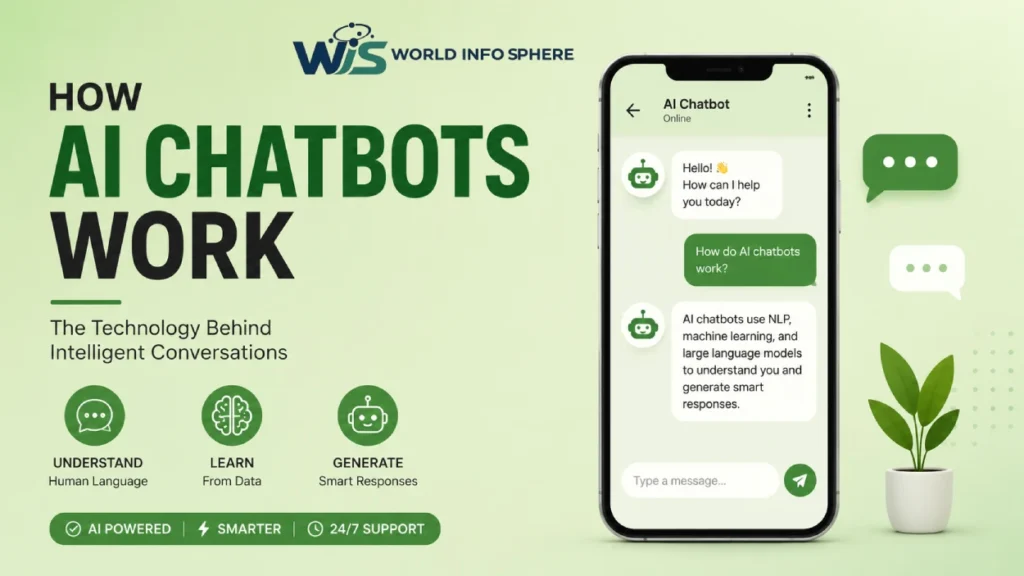
The truth is that AI chatbots are powered by a combination of advanced technologies, including Natural Language Processing (NLP), Machine Learning (ML), and Large Language Models (LLMs). Together, these technologies allow chatbots to understand human language, recognize intent, process information, and generate helpful responses.
As AI continues to become part of our daily lives, understanding how AI chatbots work is more important than ever. Whether you’re a student, business owner, content creator, marketer, or simply curious about technology, learning how these systems operate can help you use them more effectively.
If you’re completely new to AI, you may first want to explore “What is Artificial Intelligence?“ to understand the foundation behind modern chatbot technology.
In this guide, we’ll break down the entire AI chatbot working process in simple language—without complicated technical jargon.
What Is an AI Chatbot?
An AI chatbot is a software application that can communicate with humans using natural language. Unlike traditional chatbots that follow fixed rules and scripted responses, AI chatbots can understand context, interpret questions, and generate unique answers.
Think of an AI chatbot as a digital assistant that listens to what you type, analyzes the meaning behind your words, and responds based on what it has learned from large amounts of data.
Popular examples include ChatGPT, Google Gemini, Microsoft Copilot, and many customer support assistants used by businesses worldwide.
AI chatbots can help users:
- Answer questions
- Provide recommendations
- Solve customer support issues
- Generate content
- Translate languages
- Assist with research
- Automate repetitive tasks
The biggest difference between AI chatbots and traditional bots is their ability to understand language rather than simply matching keywords.
For example, if you ask:
“What’s the weather like today?”
and
“Do I need an umbrella today?”
A traditional chatbot might see these as completely different questions.
An AI chatbot understands that both questions are related to weather and can provide a relevant response.
This ability makes AI-powered conversations feel much more natural and human-like.
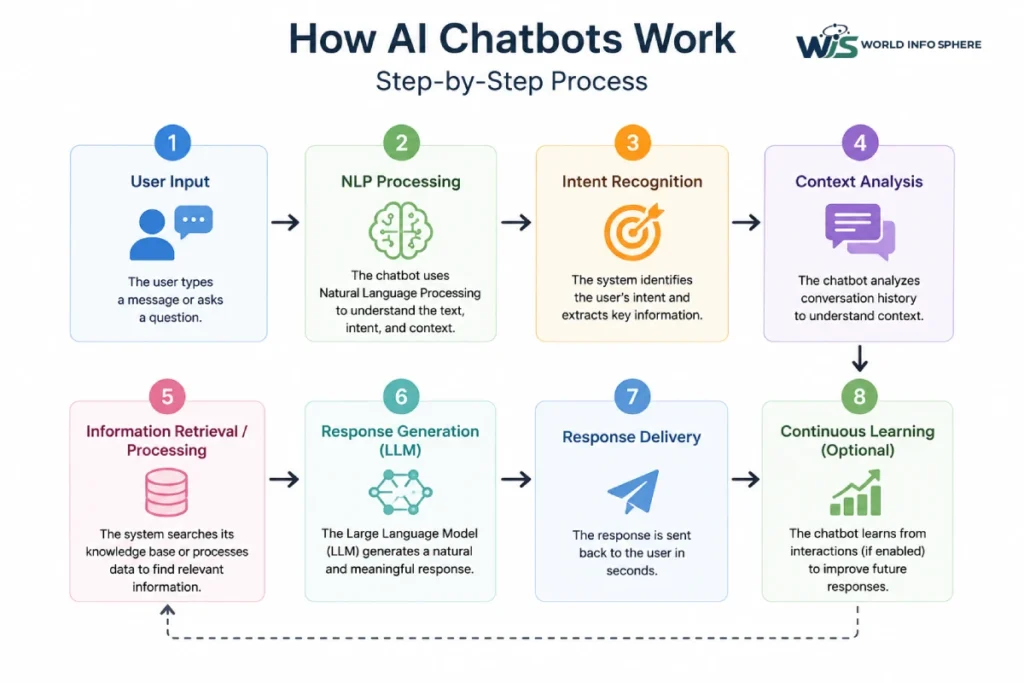
How AI Chatbots Work: Step-by-Step Process
To understand the AI chatbot working process, let’s imagine you ask ChatGPT a simple question:
“How can I improve my website’s SEO?”
Although the response appears instantly, several important steps happen behind the scenes.
Step 1: User Input
Everything starts when a user types a message.
The chatbot receives your text and begins analyzing the words, sentence structure, and context.
This stage may seem simple, but human language is often complex.
For example:
- “Apple” could refer to a fruit.
- It could also refer to a technology company.
The chatbot must determine the intended meaning before responding.
Step 2: Language Understanding
Once the message is received, the chatbot uses Natural Language Processing (NLP) to understand what you’re asking.
It identifies:
- Keywords
- Intent
- Context
- Relationships between words
For example:
Question:
“How do I rank higher on Google?”
Intent:
Learn SEO strategies.
The chatbot focuses on understanding the purpose behind the question rather than simply reading individual words.
Step 3: Context Analysis
Modern AI chatbots do more than answer single questions.
They also analyze previous messages in the conversation.
For example:
User:
“Tell me about AI.”
Later:
“How is it used in healthcare?”
The chatbot understands that “it” refers to AI.
This ability to maintain context creates smoother and more meaningful conversations.
Step 4: Information Processing
After understanding the request, the AI model processes the information using patterns it learned during training.
Instead of searching its memory like a human, it predicts which words and ideas are most likely to answer the question effectively.
This prediction process happens extremely quickly, often within fractions of a second.
Step 5: Response Generation
The chatbot generates a response based on:
- User intent
- Context
- Language patterns
- Training knowledge
The result is a natural-looking answer that feels conversational.
This entire process—from input to response—typically happens in seconds.
Natural Language Processing in Chatbots
Natural Language Processing (NLP) is one of the most important technologies behind AI chatbots.
Without NLP, chatbots would struggle to understand human language.
NLP helps computers interpret:
- Words
- Sentences
- Grammar
- Meaning
- Emotions
- Context
In simple terms, NLP acts as a translator between humans and machines.
When you type:
“Can you recommend a good AI tool for content creation?”
The chatbot doesn’t just see individual words.
NLP helps it understand that:
- You’re looking for recommendations.
- The topic is AI tools.
- The purpose is content creation.
This understanding allows the chatbot to provide a useful response instead of a generic one.
Many modern AI tools rely heavily on NLP technology to create more natural and accurate conversations.
Why NLP Is Important
Without NLP:
- Conversations would feel robotic.
- Chatbots would misunderstand questions.
- Responses would be less accurate.
With NLP:
- Better understanding
- More natural conversations
- Improved customer experience
- Higher response accuracy
This is one reason modern AI assistants feel significantly smarter than earlier chatbot generations.
Machine Learning in Chatbots
Machine Learning (ML) is another key technology that powers AI chatbots.
Machine learning allows systems to recognize patterns from large amounts of data.
Instead of manually programming every possible response, developers train AI models using millions or even billions of examples.
Over time, the model learns:
- Language patterns
- Sentence structures
- Common questions
- Human communication styles
Imagine teaching a child to recognize animals.
Rather than defining every characteristic, you show thousands of examples.
Eventually, the child begins recognizing patterns.
Machine learning works similarly.
The more quality data available during training, the better the chatbot becomes at understanding and responding to users. Machine learning is also used in many AI applications beyond chatbots, including recommendation systems, image recognition, and predictive analytics.
Large Language Models (LLMs) Explained
One of the biggest breakthroughs in modern AI chatbot technology is the development of Large Language Models, often called LLMs.
An LLM is a highly advanced AI model trained on massive amounts of text data.
Its purpose is to understand language and generate human-like responses.
Examples of LLM-powered systems include:
- ChatGPT
- Google Gemini
- Microsoft Copilot
- Claude
If you’re interested in comparing these systems, you can also explore “ChatGPT vs Gemini vs Claude – Which AI Tool is the Best?“
LLMs are capable of:
- Answering questions
- Writing articles
- Summarizing information
- Translating languages
- Generating ideas
- Assisting with coding
What makes LLMs different from older chatbot technologies is their ability to understand context at a much deeper level.
Rather than relying on predefined rules, they generate responses dynamically based on patterns learned during training.
This flexibility is what makes modern AI conversations feel so natural.
How AI Chatbots Generate Responses
One of the most common questions people ask is:
How do AI chatbots generate answers?
The process is surprisingly different from how humans think.
AI chatbots do not “know” information in the same way people do.
Instead, they use probability and prediction.
When you ask a question, the model predicts which words are most likely to come next based on patterns learned during training.
For example, if a user asks:
“What are the benefits of AI chatbots?”
The model analyzes:
- The question
- Context
- Language patterns
- Relevant concepts
It then generates a response one word at a time.
Although this process happens behind the scenes, it creates the impression of a fluid and intelligent conversation.
The quality of the response depends on several factors:
- Model training
- Context provided
- User input clarity
- Available knowledge
This is why detailed questions often produce better answers than vague ones.
As AI technology continues to evolve, response generation becomes increasingly accurate, helpful, and natural.
In the next section, we’ll explore real-world AI chatbot examples, compare AI chatbots with traditional chatbots, examine their benefits and limitations, and discuss the future of conversational AI.
AI Chatbot Examples
AI chatbots are no longer limited to tech companies. Today, they are used across industries to improve customer support, automate tasks, and provide instant assistance.
Here are some popular examples:
ChatGPT
ChatGPT is one of the most widely used AI chatbots. It can answer questions, generate content, summarize information, assist with coding, and support research tasks.
Many students, professionals, marketers, and business owners use ChatGPT daily to save time and improve productivity.
Google Gemini
Google Gemini is Google’s advanced AI assistant designed to help users search for information, create content, and perform various tasks more efficiently. If you want to learn more about Gemini, check out our guide on “What is Google Gemini AI? Google’s Most Powerful AI Technology.“
Microsoft Copilot
Microsoft Copilot integrates AI capabilities into tools like Word, Excel, PowerPoint, and other productivity applications. It helps users write documents, analyze data, create presentations, and automate repetitive work.
Customer Support Chatbots
Many businesses use AI-powered customer support chatbots on their websites.
These chatbots can:
- Answer frequently asked questions
- Track orders
- Schedule appointments
- Handle basic support requests
- Reduce customer wait times
This improves customer satisfaction while reducing operational costs.
AI Chatbot vs Traditional Chatbot
Many people assume all chatbots work the same way, but there is a significant difference between traditional chatbots and AI chatbots.
| Feature | Traditional Chatbot | AI Chatbot |
| Responses | Predefined | Dynamic |
| Learning Ability | Limited | Advanced |
| Context Understanding | Basic | Strong |
| Flexibility | Low | High |
| User Experience | Scripted | Natural |
| Problem Solving | Limited | Better |
Traditional Chatbots
Traditional chatbots operate using fixed rules and decision trees.
For example:
User: “Track my order.”
Bot: “Please enter your order number.”
If the user asks something unexpected, the chatbot may fail to provide a useful answer.
AI Chatbots
AI chatbots understand intent, context, and language patterns.
Even if users phrase questions differently, the chatbot can often understand the request and provide relevant information.
This flexibility is one reason businesses are rapidly adopting AI-powered solutions.
Benefits of AI Chatbots
AI chatbots offer advantages for both businesses and users.
1. Instant Responses
- Nobody likes waiting for answers.
- AI chatbots provide immediate responses, helping users find information quickly.
2. 24/7 Availability
- Unlike human support teams, AI chatbots can operate around the clock.
- Whether it’s day or night, users can receive assistance whenever needed.
3. Improved Customer Experience
Fast responses and personalized interactions create a smoother customer experience.
Many businesses now rely on AI-powered customer support to improve service quality.
This trend is also discussed in our article “How AI is Transforming Small Businesses | Business Growth Guide.“
4. Increased Productivity
AI chatbots can automate repetitive tasks, allowing employees to focus on more important work.
Examples include:
- Scheduling appointments
- Answering FAQs
- Managing support tickets
- Data collection
5. Cost Savings
Businesses can handle large volumes of customer inquiries without significantly increasing staffing costs.
6. Content and Creative Assistance
Modern AI chatbots can help users:
- Generate ideas
- Write articles
- Create social media captions
- Draft emails
- Brainstorm content strategies
Content creators may also find value in our guide “Best AI Tools for Content Creators and YouTubers.“
Limitations of AI Chatbots
Although AI chatbots are impressive, they are not perfect.
Understanding their limitations is important.
1. Occasional Mistakes
AI chatbots can sometimes provide inaccurate or misleading information.
This happens because they generate responses based on patterns rather than true understanding.
For important decisions, information should always be verified using reliable sources.
2. Lack of Human Judgment
AI can process information quickly, but it does not possess human intuition, empathy, or real-world experience.
Some situations still require human involvement.
3. Context Challenges
While modern chatbots handle context much better than older systems, they can occasionally misunderstand complex or ambiguous questions.
4. Data Privacy Considerations
Users should avoid sharing sensitive personal information unless they trust the platform and understand its privacy policies.
5. Dependence on Training Data
The quality of chatbot responses depends heavily on the quality and diversity of the data used during training.
Poor training data can lead to poor results.
Future of Conversational AI
The future of conversational AI looks incredibly promising.
AI chatbots are becoming smarter, faster, and more capable every year.
In the coming years, we can expect:
Better Personalization
Future chatbots will provide more personalized responses based on user preferences and context.
Improved Multimodal Capabilities
AI systems are increasingly able to understand not only text but also images, audio, videos, and documents.
More Natural Conversations
Conversations with AI will continue to become more fluid and human-like.
Wider Business Adoption
Businesses across industries are adopting AI solutions to improve efficiency and customer experience.
Enhanced Workplace Productivity
AI assistants are expected to become common workplace tools, helping employees manage tasks, create content, and analyze information more effectively.
This growing trend has also raised important questions about the future of employment, which we discuss in “Will AI Replace Human Jobs? | AI Jobs Future.“
As AI continues to evolve, understanding how these systems work will become an increasingly valuable skill.
Also, read this article:
What Is a White Hat Hacker? Complete Guide for Beginners
Meta Launches Instagram, Facebook & WhatsApp Plus Subscriptions in 2026
What is Virtual Reality (VR) ?: Explore the Future of Digital Technology
Conclusion
AI chatbots have transformed the way people interact with technology. What once seemed like a simple question-and-answer tool has evolved into a powerful system capable of understanding language, analyzing context, and generating meaningful responses. Behind every conversation lies a combination of Natural Language Processing, Machine Learning, and Large Language Models working together to create a smooth user experience. Whether you’re asking ChatGPT for advice, using a customer support assistant, or exploring the latest AI innovations, the same core technologies are making these interactions possible.
As conversational AI continues to advance, chatbots will become even more capable, personalized, and integrated into our daily lives. Understanding how AI chatbots work not only helps you use these tools more effectively but also prepares you for a future where AI-powered communication becomes an essential part of both personal and professional life.
Frequently Asked Questions (FAQs)
What Is an AI Chatbot?
An AI chatbot is a software application that uses artificial intelligence technologies such as NLP, machine learning, and large language models to understand and respond to human conversations.
How Do AI Chatbots Understand Human Language?
AI chatbots use Natural Language Processing (NLP) to analyze words, sentences, context, and user intent.
How Do AI Chatbots Generate Answers?
AI chatbots generate responses by predicting the most relevant words and phrases based on patterns learned during training.
What Is the Difference Between AI and Traditional Chatbots?
Traditional chatbots rely on predefined rules, while AI chatbots can understand language, context, and intent to generate more flexible responses.
Are AI Chatbots Accurate?
AI chatbots are often highly useful, but they are not always perfect. Users should verify important information from trusted sources.
What Technologies Power AI Chatbots?
Modern AI chatbots typically use:
1. Natural Language Processing (NLP)
2. Machine Learning (ML)
3. Large Language Models (LLMs)
4. Deep Learning
5. Conversational AI Systems