Introduction
Education in 2026 is going through a major shift. If we compare it with just a few years ago, the difference is very clear. Earlier, students mostly depended on textbooks, classroom teaching, and handwritten notes. Now, learning is becoming more digital, interactive, and personalized.
Artificial Intelligence (AI) and digital learning tools are no longer “future ideas”—they are part of daily education. Students are using AI tutors, online platforms, smart classrooms, and even virtual reality to understand subjects better.
This blog explains how AI and digital learning are shaping the future of education in 2026, with real-life style examples so it is easy to understand.
Education is Becoming More Personal in 2026
One of the biggest changes in education today is personalized learning.
In traditional classrooms, one teacher teaches the same topic to all students at the same speed. But every student is different—some understand quickly, others need more time.
Now AI is solving this problem.
Example:
Imagine a student named Priya who is weak in mathematics. Earlier, she would wait for extra classes or tutoring. Now, she uses an AI learning app.
The app:
- Detects her weak areas (like fractions and equations)
- Gives her simple step-by-step explanations
- Provides practice questions based on her level
- Tracks her progress daily
This means Priya is no longer learning at the class speed—she is learning at her own speed.
This is called adaptive learning, and it is becoming very common in 2026.
AI Tutors are Replacing Traditional Doubt Solving
Students no longer need to wait for teachers to clear doubts.
AI tools can now act like 24/7 tutors.
Example:
A student is studying science at midnight and doesn’t understand a concept like “photosynthesis.”
Instead of waiting for school, he asks an AI tutor:
- The AI explains the concept in simple language
- Shows diagrams
- Gives real-life examples (like plants making food using sunlight)
- Even provides a short quiz to test understanding
This instant help improves learning speed and confidence.
Digital Classrooms are Becoming Normal
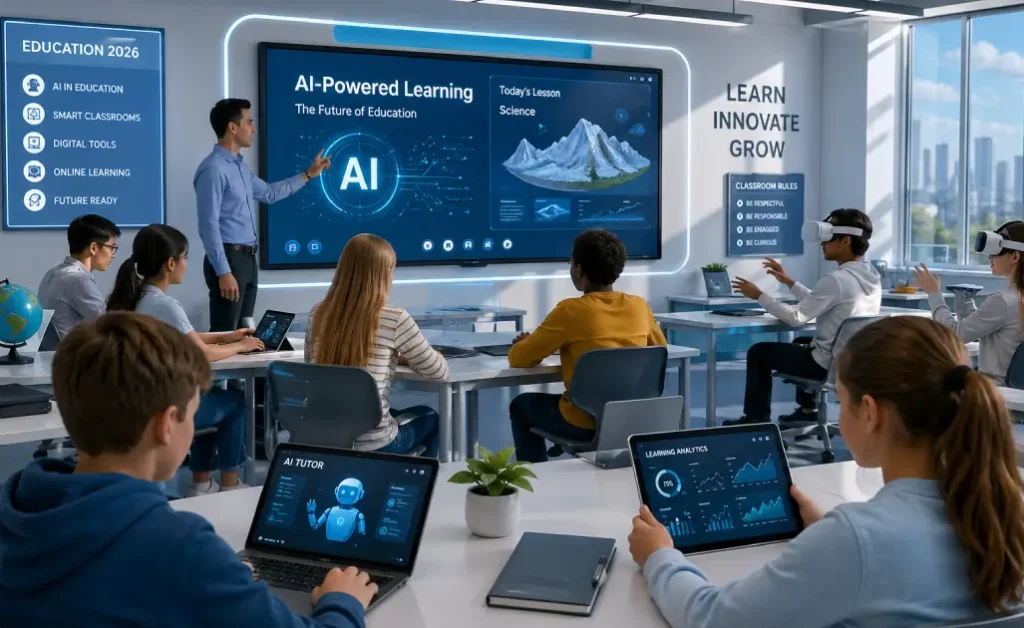
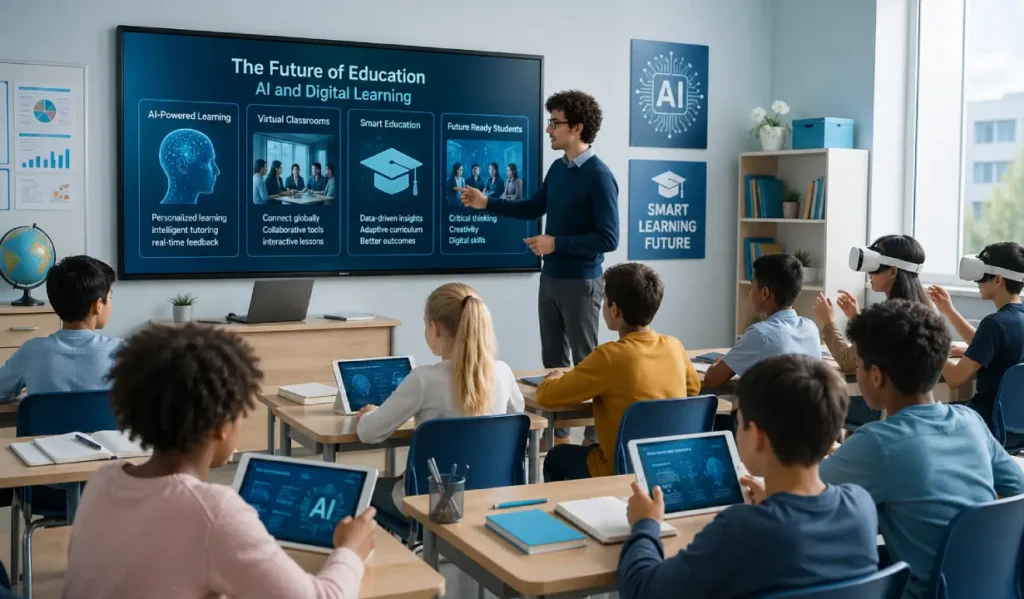
In 2026, classrooms are not just physical rooms anymore. Many schools are using hybrid learning models, where both offline and online methods are combined.
Example:
A school in a city uses smart classrooms where:
- Teachers use digital boards instead of chalk
- Videos and animations explain topics
- Students answer questions using tablets
- Attendance is recorded digitally
At the same time, students who are absent can attend the same class online from home.
This ensures that no student misses learning.
Learning is Now More Visual and Interactive
One major advantage of digital education is that learning is no longer boring.
Instead of just reading theory, students now see and experience concepts.
Example:
In a biology class:
- Students watch a 3D animation of the human heart
- They rotate it, zoom it, and see how blood flows
- They even perform virtual experiments safely
In history:
- Students can “visit” ancient civilizations using VR headsets
This type of learning improves memory and understanding because students experience the concept instead of just reading it.
Online Learning Platforms are Expanding Education Access
Education is no longer limited to schools or universities.
Platforms like online learning apps and websites allow students to learn anything from anywhere.
Example:
A student in a small town wants to learn coding. Instead of waiting for a coaching center, he joins an online course.
He can:
- Watch video lessons anytime
- Practice coding exercises
- Join live sessions with mentors
- Build real projects step by step
This is why online education in 2026 is becoming very powerful—it removes location barriers.
AI is Helping Teachers Too
AI is not only helping students—it is also supporting teachers.
Example:
A teacher has 60 students in a class. Checking every assignment manually takes a lot of time.
Now AI tools can:
- Automatically check objective answers
- Highlight common mistakes
- Suggest improvement areas for students
- Help teachers create lesson plans
This allows teachers to focus more on teaching instead of paperwork.
Education is Becoming Skill-Based
Earlier, students focused mainly on exams and marks. In 2026, the focus is shifting toward skills and real-world knowledge.
Example:
Instead of only studying theory in marketing, students now:
- Run small online campaigns
- Learn SEO and social media marketing
- Create real content projects
- Build portfolios before graduating
Companies now prefer students who can do work, not just remember answers.
Challenges of AI and Digital Education
Even though technology is improving education, it also brings challenges.
1. Distraction Problem
Students may get distracted by social media or games on the same device used for study.
2. Over-Dependence on AI
Some students may rely too much on AI instead of thinking on their own.
3. Health Issues
Long screen time can cause:
- Eye strain
- Headaches
- Lack of physical activity
4. Unequal Access
Not all students have high-speed internet or devices, which creates a gap in learning opportunities.
Real-Life Learning Scenario in 2026
Let’s understand everything with a simple real-life scenario:
Bharat is a college student.
His daily learning routine:
- Attends online lectures in the morning
- Uses AI to revise topics
- Watches VR-based practical lessons in science
- Completes assignments through digital platforms
- Joins group discussions online
At the same time, he also attends physical labs for hands-on experience.
This mix of digital + physical education is becoming the new normal.
Future of Education Beyond 2026
Education will continue to evolve in the coming years. Some future trends include:
- Fully AI-powered personalized learning systems
- Virtual reality classrooms replacing physical labs
- Global classrooms where students from different countries study together
- Real-time language translation in classes
- More focus on creativity and problem-solving instead of memorization
The goal of future education is simple:
Learn better, faster, and in a more practical way.
Conclusion
The future of education in 2026 is deeply connected with AI and digital learning. It is making education more flexible, personalized, and accessible for students around the world.
Students are no longer limited to textbooks or classrooms. They now have access to global knowledge, AI tutors, and interactive learning systems.
However, success in this new system depends on balance. Technology should be used as a tool for learning, not as a distraction.
The students who adapt to AI, digital platforms, and skill-based learning will be the ones who succeed in the future.
Education is no longer just about studying—it is about evolving with technology and preparing for the real world.
FAQs (Frequently Asked Questions)
1. What is the role of AI in education in 2026?
AI plays a major role in education by acting as a personal tutor for students. It helps in explaining difficult topics, giving instant answers, checking performance, and creating personalized learning plans based on each student’s level.
2. How is digital learning better than traditional education?
Digital learning is more flexible and interactive. Students can learn anytime, anywhere, and at their own pace. It also uses videos, animations, and AI tools which make learning easier and more interesting compared to traditional textbook-based learning.
3. Are smart classrooms replacing traditional classrooms?
Not completely, but smart classrooms are becoming very common. Many schools now use digital boards, online assignments, and video-based lessons along with traditional teaching methods in a hybrid model.
4. What are the main benefits of AI in student learning?
AI helps students learn faster by offering personalized lessons, instant doubt solving, progress tracking, and practice tests. It also saves time and helps students focus on their weak areas more effectively.
5. What challenges do students face with digital education?
Some common challenges include distraction from social media, eye strain from too much screen time, lack of physical interaction, and unequal access to devices or internet in some areas.