Introduction
Education in 2026 is changing faster than ever before. If we compare today’s classrooms with those from a few years ago, the difference is very clear. Chalkboards are being replaced with digital screens, textbooks are becoming e-books, and traditional teaching is now supported by Artificial Intelligence (AI).
When we look at real Google search trends, people are mostly searching for:
- “smart classrooms”
- “AI in education benefits”
- “impact of technology on students”
- “future of education system”
- “digital learning vs traditional learning”
This shows one clear thing—students, teachers, and parents all want to understand how technology is shaping education.
In this blog, we will explain how education is moving from smart classrooms to AI learning, and what real impact it is creating in 2026.
1. What are Smart Classrooms in 2026?
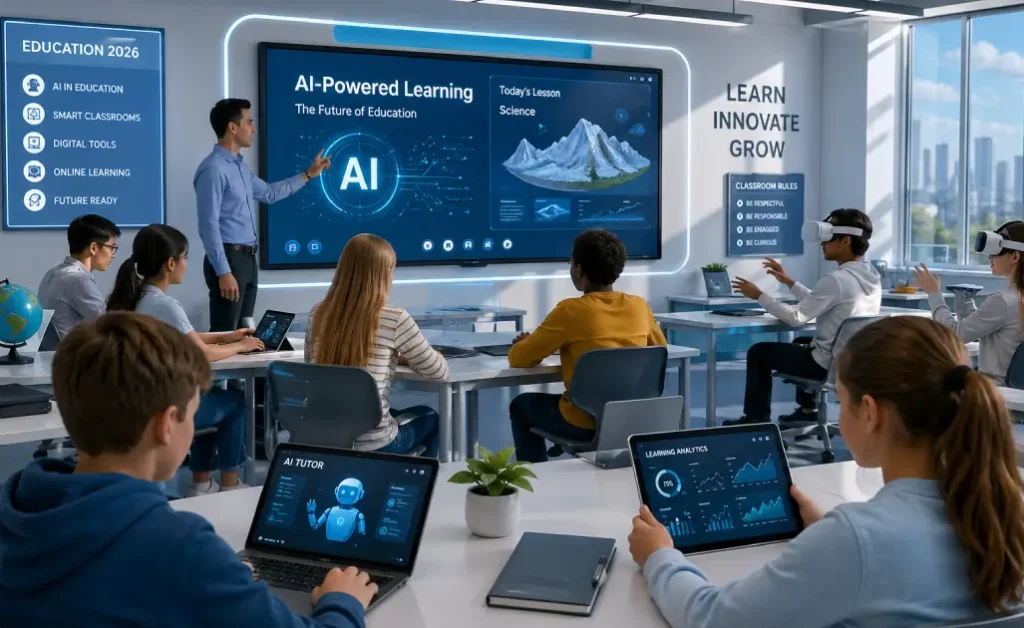
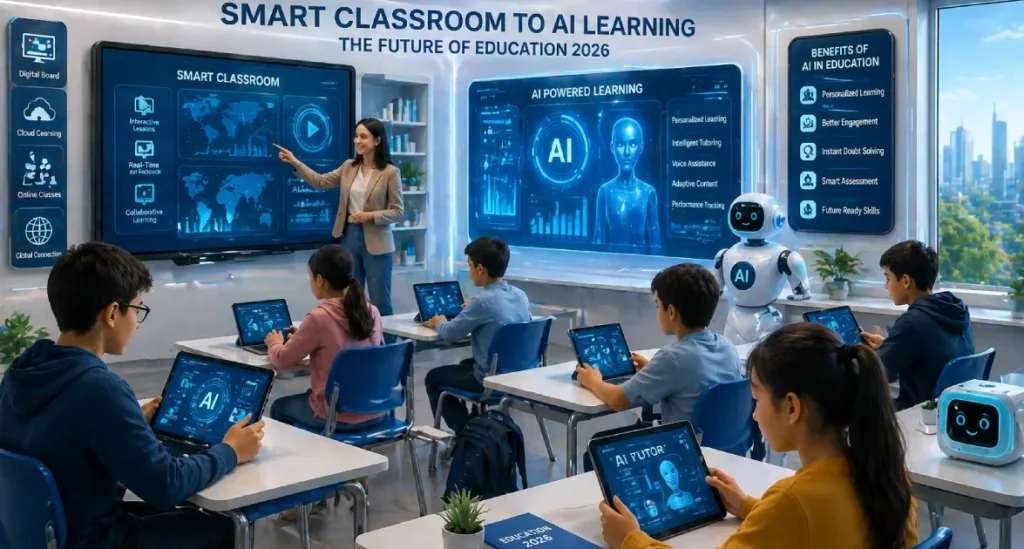
A smart classroom is a modern classroom where technology is used to make learning easier, faster, and more interactive.
Instead of only using books and chalk, teachers now use:
- Digital smart boards
- Projectors and interactive screens
- Tablets for students
- Video-based lessons
Example:
In a science class, instead of just reading about volcanoes, students watch a 3D animation showing how a volcano erupts in real time.
Result:
- Better understanding
- More student engagement
- Less boring traditional lectures
Related reading:
How Digital Technology is Changing Education in 2026
2. AI is Taking Learning to the Next Level
While smart classrooms improved teaching, AI is now improving personal learning.
Artificial Intelligence in education is acting like a personal tutor for students.
Example:
A student who is weak in mathematics uses an AI learning app.
The AI:
- Detects weak topics
- Explains concepts step-by-step
- Gives practice problems
- Tracks progress daily
This means every student gets a custom learning experience.
Related blog:
Future of Education in 2026: AI and Digital Learning Impact
3. From One-Size Teaching to Personalized Learning
Earlier, all students were taught the same lesson at the same speed. But in 2026, learning is becoming personalized.
Example:
- Fast learners get advanced content
- Slow learners get extra support
- AI adjusts lessons based on performance
This system ensures no student is left behind.
4. Digital Tools are Making Learning More Interactive
Students today don’t just read—they experience learning.
Example:
- VR (Virtual Reality) lets students explore space or historical places
- AR (Augmented Reality) shows 3D models in real time
- Educational apps turn lessons into games
Result:
- Higher attention span
- Better memory retention
- More interest in studies
5. Online Learning is Expanding Education Access
Education is no longer limited to physical schools.
Example:
A student in a small village can attend:
- Live classes from top teachers
- Recorded lectures anytime
- Online exams and quizzes
This is made possible by online education platforms in 2026.
6. Teachers are Becoming Technology Guides
Technology is not replacing teachers—it is supporting them.
Example:
Teachers now:
- Use AI tools to check assignments
- Create digital study materials
- Track student performance automatically
This gives teachers more time to focus on explaining concepts clearly.
7. Real-Life Learning Example in 2026
Let’s understand with a real example:
A student named Arjun studies in a modern school.
His routine:
- Attends smart classroom lessons
- Uses AI app for homework help
- Watches VR science experiments
- Joins online group discussions
- Takes digital tests
At the same time, he also attends physical classes for practical learning.
This combination of smart classrooms + AI learning is the future model.
8. Challenges of Technology in Education
Even though technology is powerful, it also has challenges:
1. Distraction Problem
Students may get distracted by social media on the same devices used for study.
2. Screen Time Issues
Too much screen time can cause eye strain and fatigue.
3. Lack of Social Interaction
Online learning reduces face-to-face communication skills.
4. Digital Gap
Not all students have equal access to the internet and smart devices.
9. Future of Education Beyond 2026
Education will continue to evolve even more.
We can expect:
- Fully AI-powered schools
- Virtual reality classrooms everywhere
- Global classrooms with students from different countries
- Real-time language translation in lectures
- Fully skill-based education systems
Conclusion
The journey from smart classrooms to AI learning shows how fast education is changing in 2026. Technology is making learning more flexible, personalized, and interactive.
Students now have access to better tools, better teaching methods, and global knowledge. However, it is also important to use technology wisely and maintain balance.
The future of education is clear:
Technology + Learning + AI = Smarter Education System
Students who adapt to this change will be better prepared for the future world.
FAQs (Frequently Asked Questions)
What are smart classrooms in 2026?
Smart classrooms in 2026 are modern learning spaces where teachers use digital boards, interactive screens, tablets, and video-based lessons to make education more engaging and easy to understand for students.
How is AI used in education in 2026?
AI in education 2026 is used as a personal learning assistant. It helps students understand topics, solve problems, check progress, and create personalized study plans based on their learning speed and ability.
What is the difference between smart classrooms and AI learning?
Smart classrooms focus on improving teaching using technology inside the classroom, while AI learning focuses on personalized education for each student outside or inside the classroom using smart tools and apps.
What are the benefits of smart classrooms in education?
The main benefits of smart classrooms in 2026 include better understanding through visuals, higher student engagement, faster learning, and interactive lessons that make studying more interesting.
What are the challenges of AI and smart learning in education?
Some challenges include screen time issues, distraction from social media, lack of physical interaction, and unequal access to devices and internet for all students.