Introduction
Artificial Intelligence is no longer just a futuristic concept—it is now part of our daily lives. From voice assistants to recommendation systems, AI is everywhere. One of the most powerful and widely used AI tools today is ChatGPT.
Whether you are a student, blogger, developer, or business owner, you’ve probably heard about ChatGPT or even used it. But most people only understand it at a surface level.
“ChatGPT is one of the most powerful AI tools available today. If you’re new to AI, you should also explore our guide on
Best AI Tools for Beginners in 2026 to understand other useful tools.”
This guide goes much deeper.
In this advanced blog, you will learn:
- What ChatGPT really is
- How it works technically (in simple language)
- Real-world use cases
- Benefits and limitations
- How to use it like a pro
- The future of AI
What is ChatGPT?
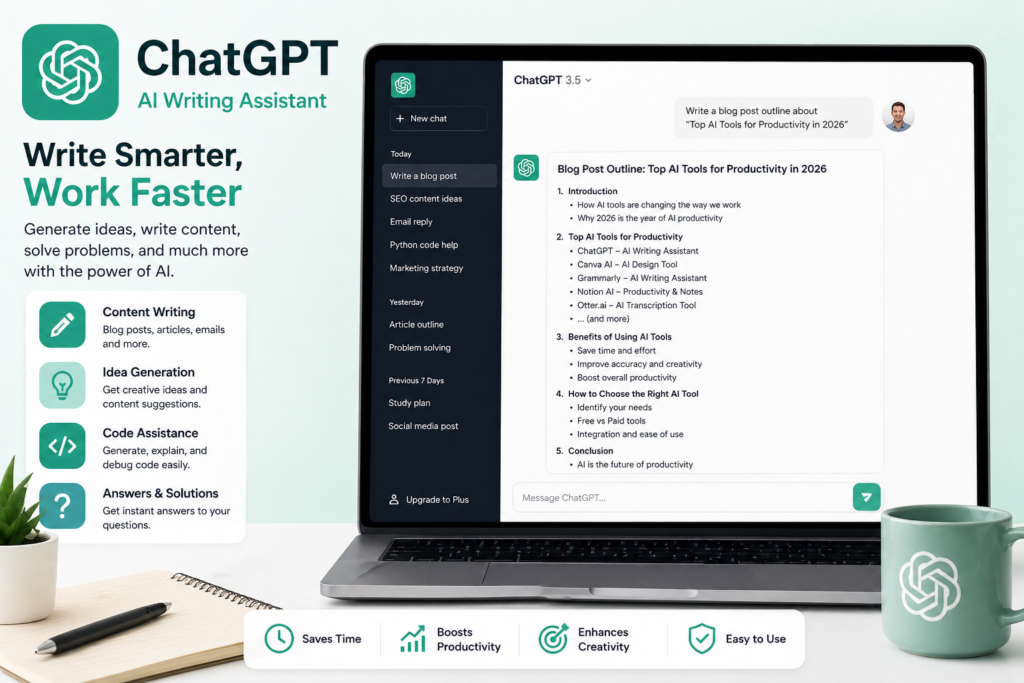
ChatGPT is an AI-powered conversational chatbot developed by OpenAI. It is designed to understand human language and respond in a natural, human-like way.
The name ChatGPT stands for:
- Chat → Conversation
- GPT → Generative Pre-trained Transformer
ChatGPT is a tool that can read, write, think (pattern-based), and respond like a human.
It can help with:
- Writing blogs
- Answering questions
- Generating code
- Explaining concepts
- Brainstorming ideas
Evolution of ChatGPT
To understand ChatGPT better, it’s important to look at how it evolved.
Early AI Chatbots
Before ChatGPT, chatbots were very basic:
- Rule-based responses
- Limited understanding
- Robotic replies
Breakthrough with GPT Models
OpenAI introduced GPT models:
- GPT-1 → Basic text generation
- GPT-2 → Better coherence
- GPT-3 → Human-like responses
- GPT-4 and beyond → Advanced reasoning
This evolution made ChatGPT powerful and useful for real-world tasks.
Core Technology Behind ChatGPT
ChatGPT is built using advanced AI concepts. Let’s break them down in simple language.
1. Natural Language Processing (NLP)
ChatGPT uses Natural Language Processing to understand and generate human language.
This allows it to:
- Understand questions
- Detect meaning
- Generate accurate responses
2. Machine Learning
ChatGPT is trained using machine learning, meaning it learns from data instead of being manually programmed.
It studies:
- Billions of sentences
- Different writing styles
- Context and patterns
3. Transformer Architecture
The most important technology behind ChatGPT is the Transformer model.
Key features:
- Understands context
- Processes entire sentences at once
- Remembers conversation flow
This is what makes ChatGPT different from older AI systems.
How ChatGPT Works (Step-by-Step Explanation)
Let’s break down the working process in a simple but advanced way.
Step 1: Input Processing
When you type a prompt, ChatGPT:
- Reads the input
- Breaks it into tokens (small parts)
- Understands the structure
Example:
“Write a blog on fitness”
→ Tokens: Write | blog | fitness
Step 2: Context Understanding
The model analyzes:
- What you want (task)
- Topic (subject)
- Tone (formal, casual, etc.)
It also considers previous conversations if any.
Step 3: Prediction Engine
ChatGPT does not “think” like humans.
Instead, it:
Predicts the next word based on probability
Example:
“The sky is…”
→ Most likely next word = “blue”
Step 4: Response Generation
It builds sentences word-by-word:
- Grammatically correct
- Context-aware
- Human-like
Step 5: Output Delivery
Finally, you receive a structured, readable answer.
Simple Analogy to Understand ChatGPT
Think of ChatGPT like:
A super-smart autocomplete system
But instead of completing one word, it completes:
- Sentences
- Paragraphs
- Entire articles
Real-World Examples of ChatGPT
Let’s explore practical examples.
Example 1: Blogging
Prompt:
“Write a blog on digital marketing”
Output:
A full article with headings, content, and structure.
Example 2: Coding
Prompt:
“Create a login page in HTML and CSS”
Output:
Ready-to-use code.
Example 3: Education
Prompt:
“Explain gravity in simple terms”
Output:
Easy-to-understand explanation for students.
Example 4: Business Emails
Prompt:
“Write a professional email for job application”
Output:
Polished, professional email.
Advanced Use Cases of ChatGPT
ChatGPT is not just a basic chatbot—it’s a powerful productivity tool.
1. SEO Content Creation
You can:
- Generate blog ideas
- Write articles
- Optimize keywords
- Create meta descriptions
2. Automation
Businesses use ChatGPT for:
- Customer support
- Chatbots
- Workflow automation
3. Programming Assistant
Developers use it to:
- Debug code
- Learn programming
- Generate scripts
4. Marketing
Marketers use it for:
- Ad copy
- Email campaigns
- Social media posts
5. Learning & Skill Development
You can learn:
- Coding
- Writing
- Languages
- Business strategies
Benefits of ChatGPT
1. Saves Time
Tasks that take hours can be done in minutes.
2. Increases Productivity
You can do more work in less time.
3. Easy to Use
No technical knowledge required.
4. Multi-Tasking Ability
Handles writing, coding, learning, and more.
5. Cost-Effective
Reduces need for multiple tools or services.
Limitations of ChatGPT
It’s important to understand the downsides.
1. Not Always Accurate
Sometimes it may give incorrect or outdated information.
2. No True Understanding
It does not “think” or “feel”—it predicts patterns.
3. Depends on Prompt Quality
Better input = better output.
4. Limited Real-Time Knowledge
Without external tools, it may not know current events.
How to Use ChatGPT Like a Pro
Here are advanced tips most beginners don’t know.
1. Use Detailed Prompts
Instead of:
❌ “Write blog”
Use:
✅ “Write a 1500-word SEO blog on fitness for beginners with headings and examples”
2. Use Role-Based Prompts
Example:
“Act as an SEO expert and write a blog”
3. Break Tasks into Steps
Instead of one big request:
- Ask for outline
- Then content
- Then optimization
4. Ask for Revisions
Example:
- “Make it simpler”
- “Add examples”
- “Improve SEO”
5. Combine with Other Tools
Use ChatGPT with:
- Design tools
- SEO tools
- Automation tools
ChatGPT vs Traditional Search Engines
| Feature | ChatGPT | Search Engines |
| Response Type | Direct answers | List of links |
| Speed | Instant | Depends |
| Interaction | Conversational | One-way |
| Personalization | High | Limited |
Is ChatGPT Replacing Humans?
Short answer: No.
There is always a debate between machines and humans. Read our full comparison on
AI vs Human Intelligence to understand the differences.”
ChatGPT is a tool, not a replacement.
Humans are still needed for:
- Creativity
- Decision-making
- Emotional intelligence
Best approach:
Use ChatGPT as an assistant, not a replacement.
Future of ChatGPT and AI
The future of AI is very powerful.
We can expect:
- Better accuracy
- More human-like conversations
- Integration with apps
- Voice and video AI
- Smarter automation
AI will become a daily companion in work and life.
Conclusion
ChatGPT is one of the most powerful AI tools of this generation. It is changing how people write, learn, work, and communicate.
Understanding how ChatGPT works gives you a huge advantage in today’s digital world.
If you use it smartly, it can:
- Save time
- Increase productivity
- Help you grow faster
The future belongs to people who know how to use AI effectively.
FAQs (Frequently Asked Questions)
Q1: What is ChatGPT?
ChatGPT is an AI chatbot developed by OpenAI that can generate human-like text and help with multiple tasks.
Q2: How does ChatGPT work?
It uses machine learning and transformer models to understand and generate responses.
Q3: Is ChatGPT free?
Yes, there is a free version along with paid plans.