Table of Contents
Search engine optimization is changing as people increasingly use AI-powered search experiences to find information, compare products, and solve problems. Instead of clicking through several websites to find an answer, users may now see AI-generated summaries alongside links to relevant sources.
For website owners, this creates an important question: how can you make your website easier for search engines and AI-powered search systems to understand?
The answer does not involve chasing every new SEO trend or relying on secret optimization techniques. It starts with the fundamentals: useful content, clear website structure, accessible pages, accurate information, and a good experience for visitors.
AI SEO is often used to describe the work of improving a website’s visibility in AI-powered search experiences. Although the terminology is evolving, the underlying principles remain closely connected to traditional SEO.
In this guide, you will learn how AI search works at a high level, how to improve your website content, which technical SEO elements deserve attention, and how to measure your progress without relying on unrealistic promises.
What Is AI SEO?
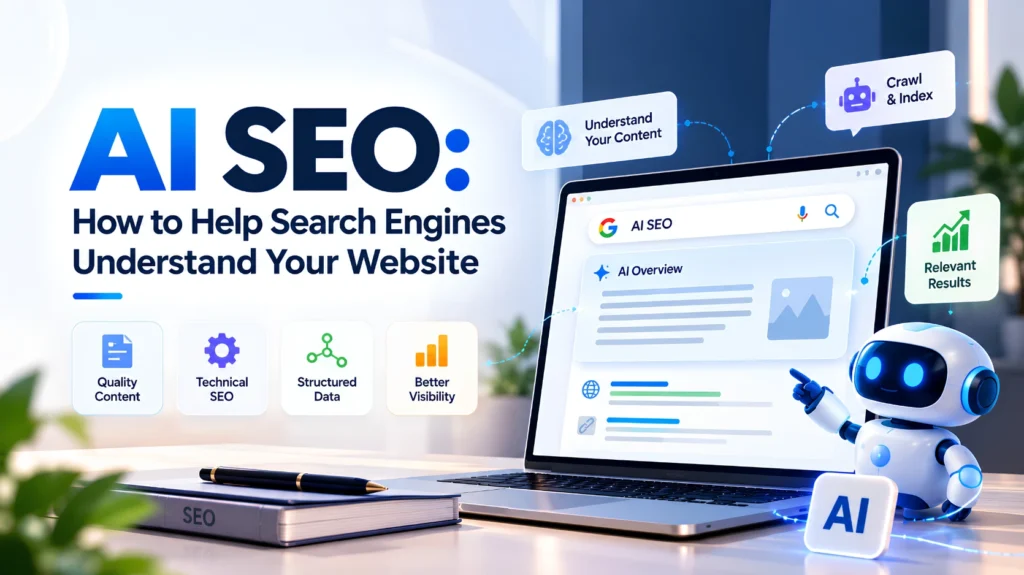
AI SEO refers to optimizing website content and its technical foundation so that search systems can discover, understand, and potentially surface it in relevant search experiences powered by artificial intelligence.
Traditional SEO focuses on helping search engines discover pages, understand their relevance, and determine whether they should appear in search results. AI-powered search introduces additional ways for users to receive information, including generated summaries and answers that reference web sources.
For example, imagine someone searches for “How can a small business improve its online visibility?”
A traditional search may display a list of relevant webpages. An AI-powered search experience may summarize several approaches, such as improving local SEO, publishing helpful content, and maintaining an accurate business profile, while providing links to sources for further reading.
If your website contains useful, accurate information about these subjects, it may be relevant to such a search. However, appearing in an AI-generated answer is not guaranteed, even if your content is indexed and follows SEO best practices.
AI SEO is therefore not a replacement for traditional SEO. It is a way of approaching website optimization with both conventional search results and newer AI-powered experiences in mind.
How Do AI Search Engines Understand Website Content?
Search systems use a combination of crawling, indexing, ranking, and other information-processing techniques to identify relevant content. AI-powered search features may also use AI models to interpret questions, retrieve information, and generate responses.
The exact process differs between platforms, and the internal systems are not identical. Nevertheless, understanding a few basic concepts helps explain why website structure and content quality matter.
1. Crawling and Discovering Pages
Crawling is the process through which a search engine visits accessible webpages to discover and process their content.
Search engines may discover pages through links from other pages, XML sitemaps, and previously known URLs. A sitemap can help communicate which URLs you want search engines to discover, but submitting one does not guarantee that every page will be crawled or indexed.
If important pages cannot be accessed because of incorrect technical settings, search engines may have difficulty discovering or processing them.
For example, a business might publish a detailed page about its website development services but accidentally block crawling through a configuration error. Even well-written content cannot compensate for a technical problem that prevents a search engine from accessing the page.
2. Indexing Website Information
After discovering a page, a search engine may process its content and consider whether to include it in its index.
An index is a collection of information about webpages that a search engine can retrieve when responding to relevant queries.
Indexing is not automatic for every discovered URL. Search engines consider various technical and quality-related factors, and they do not guarantee that every page will be included.
You can use Google Search Console to inspect individual URLs, review their reported indexing status, and investigate potential issues. Remember that an indexed page is not guaranteed to rank highly or appear in an AI-generated answer.
3. Understanding Meaning and Context
Search systems need to determine what a page is about and how its information relates to a user’s query.
Clear writing helps communicate this meaning. Descriptive headings, relevant terminology, logical paragraphs, and specific examples can make the purpose of a page easier to understand.
Consider two explanations of a website’s services.
The first says, “We provide innovative, advanced, world-class digital solutions for every business.“
The second says, “We design business websites, improve on-page SEO, and help companies build a stronger online presence.“
The second explanation gives readers a clearer understanding of the services being offered. It also provides more specific information about the page’s subject.
This does not mean every sentence should be written for a machine. Clear communication benefits human readers first, and it also helps search systems interpret the content.
7 Practical Ways to Improve Your Website for AI Search
There is no single technique that guarantees visibility across every AI-powered search platform. The most reliable approach is to strengthen the content and technical elements that help search systems discover and understand your website.
1. Create Helpful, Original, and Reliable Content
Content quality should be the starting point of any AI SEO strategy.
Publishing many articles does not automatically make a website more useful or authoritative. A page should address a genuine need and provide information that readers can understand and apply.
Before writing a blog post, ask yourself:
- What question is the reader trying to answer?
- What information do they need to make a decision?
- What common mistakes or misunderstandings should the article clarify?
- Can I provide a useful example, explanation, or perspective beyond a basic summary?
For example, a blog about improving website speed should explain practical steps such as reviewing image sizes, reducing unnecessary scripts, and testing performance. It should not simply repeat that a fast website is important.
Originality also matters. Add relevant examples, practical observations, comparisons, or explanations that genuinely improve the article. If you use statistics or make technical claims, verify them against reliable sources.
Avoid copying competitors’ articles or publishing lightly rewritten versions of existing content. A useful article should offer value in its own right, rather than existing only to target a keyword.
2. Use Clear Headings and a Logical Content Structure
A well-organized webpage helps readers find information without having to work through a long, unstructured block of text.
Use a clear heading hierarchy:
- H1: The main title of the page.
- H2: The major sections of the article.
- H3: Supporting topics within those sections.
- H4: More detailed subsections, when genuinely needed.
For example, an article about AI SEO could use an H2 heading called “How to Improve Your Website Content” and H3 headings such as “Write Helpful Answers” and “Use Descriptive Headings.”
Each heading should accurately describe the information that follows it. Avoid adding headings simply to repeat keywords.
Break up long paragraphs where necessary, explain technical terms, and use bullet points when they make instructions easier to follow. A comparison table may be useful when readers need to evaluate different options.
There is no magic number of words or headings that guarantees better rankings. The objective is to make the article complete enough to answer the reader’s question while keeping it easy to navigate.
3. Answer Important Questions Directly
People search using different types of questions. Some want a definition, others need instructions, and some are comparing products or services.
Your content should match the intent behind the search.
For example, if your heading is “What Is Technical SEO?”, begin with a clear explanation of technical SEO before moving into its components and benefits.
If the heading is “How Can You Improve Website Indexing?”, start with practical actions such as checking indexing reports, reviewing crawl restrictions, and inspecting internal links.
A useful structure is:
- Give a direct answer.
- Explain why the answer matters.
- Provide steps, examples, or supporting evidence.
- Mention relevant limitations or exceptions.
This approach makes information easier for readers to use and helps keep the content focused.
However, do not assume that short answers automatically perform better in AI search. Some questions require detailed explanations, while others can be answered briefly. Choose the depth that genuinely serves the reader.
4. Improve Technical SEO and Website Accessibility
Even excellent content needs a technically sound foundation.
Review the following elements regularly.
Check crawling permissions: Make sure important pages are not unintentionally blocked by robots.txt rules or other infrastructure settings.
Review indexing directives: Check for accidental noindex directives or incorrect canonical tags that could affect how search engines handle your pages.
Maintain a useful XML sitemap: Include the canonical URLs of important pages that you want search engines to discover. Keep the sitemap accurate and update it when your website changes.
Use crawlable internal links: Ensure important pages can be reached through ordinary links that search engines can process. Do not rely entirely on inaccessible navigation elements.
Check mobile usability and page experience: Make sure visitors can read content and use the website comfortably on different screen sizes. Review loading performance, layout stability, and interactivity where relevant.
Keep important information accessible as text: If essential details appear only inside an image, video, or inaccessible interface, some systems may have difficulty processing that information. Provide meaningful text alongside media when appropriate.
Google Search Console can help you investigate indexing and performance issues. Bing Webmaster Tools provides additional diagnostics for websites appearing in Bing-powered search experiences.
These checks do not guarantee AI citations. They help address avoidable barriers that could prevent your content from being discovered or understood.
5. Build Relevant Internal Links
Internal links connect one page of your website to another. They help visitors discover related information and can help search engines find pages and understand how website content is connected.
Imagine you have three articles:
- A guide to AI SEO.
- A guide to technical SEO.
- A guide to creating SEO-friendly content.
Linking these articles where the relationship is genuinely useful creates a clearer path for readers who want to explore the topic further.
Use descriptive anchor text. For example, “learn more about technical SEO” is more informative than “click here” when linking to a technical SEO guide.
You should also make sure important pages are not isolated from the rest of your website. Service pages, key guides, and useful resources should be linked from relevant sections wherever it makes sense.
Avoid adding unrelated links simply to increase their number. The purpose of internal linking is to help visitors navigate your content and discover information that supports their needs.
6. Use Structured Data Correctly
Structured data is a standardized way of describing information on a webpage so that supported search systems can interpret specific details more consistently.
For example, an eligible business website might use appropriate Organization or LocalBusiness structured data to describe its identity and business details. An article might use Article structured data to communicate information such as its headline, author, and publication date.
When implementing structured data:
- Choose a schema type that accurately represents the page.
- Ensure the marked-up information matches what visitors can see.
- Follow the relevant search engine documentation.
- Validate your markup and correct errors.
- Keep information accurate when the page changes.
Structured data can help search engines understand supported information and may make a page eligible for certain search features. However, it does not guarantee a rich result, higher rankings, or inclusion in an AI-generated answer.
There is also no special AI schema that every website must add to appear in Google AI Overviews or AI Mode. Follow the actual requirements for the search features you want to support rather than implementing markup based on unverified promises.
7. Keep Your Website Accurate and Up to Date
A page that was accurate several years ago may contain outdated information today, particularly when it covers technology, software, regulations, or industry practices.
Review important pages periodically and check whether their information remains correct.
Look for:
- Outdated statistics or references.
- Broken links to external resources.
- Old screenshots or instructions that no longer match a product.
- Services, prices, or features that have changed.
- Claims that need stronger evidence.
- Questions that the article does not adequately answer.
Update the content where there is a meaningful improvement to make. Do not change a publication date simply to make an article appear fresh when its information has not been reviewed.
A useful update improves accuracy, completeness, or relevance. It is not merely a date change or a way to insert a current year into an evergreen article.
Does Traditional SEO Still Matter for AI Search?
Yes. Traditional SEO remains an important foundation for visibility in AI-powered search experiences.
Google’s published guidance explains that AI Overviews and AI Mode use its core Search systems and that established SEO best practices remain relevant. A page must meet the applicable technical requirements to be eligible as a supporting link, but eligibility does not guarantee that it will be displayed.
Traditional SEO helps establish the basics:
- Search engines can discover and process your pages.
- Content addresses relevant questions and topics.
- Page titles and headings accurately describe the content.
- Internal links help connect related information.
- Technical issues do not unnecessarily prevent access.
- Content provides useful information for visitors.
AI-powered experiences may present information differently from conventional search results, but that does not mean website owners should abandon established SEO practices.
Instead, focus on making your website a useful source of information that can be discovered through the search systems relevant to your audience.
Common AI SEO Mistakes to Avoid
Some optimization advice promises fast results through shortcuts. Be careful with techniques that lack reliable evidence or encourage you to prioritize search engines over readers.
Keyword stuffing: Repeating “AI SEO” in every paragraph makes the writing unnatural. Use keywords where they accurately describe the subject.
Publishing generic AI-generated articles at scale: AI tools can support research and drafting, but publishing large volumes of unoriginal content without meaningful review or added value can create quality and spam-policy risks.
Adding unnecessary schema markup: Structured data should describe real information on the page. More markup does not automatically produce better results.
Ignoring technical problems: A useful article can still struggle to appear in search if it cannot be crawled, is not indexed, or has other technical limitations.
Chasing unverified AI tricks: Do not assume that special text files, repeated question-and-answer blocks, or other unproven tactics are required for AI visibility.
Expecting guaranteed citations: No legitimate SEO strategy can promise that every article will appear in an AI-generated answer. Search results and citations can vary by query, platform, and time.
The better approach is to build a website that consistently provides accurate, relevant, accessible, and useful information.
How to Measure Your AI SEO Performance
SEO improvements should be evaluated using evidence rather than assumptions. Start with the data available from search and analytics tools, then review AI-specific visibility where reporting is supported.
Google Search Console
Google Search Console helps you monitor how your website performs in Google Search.
Useful reports and features include:
- Performance: Review clicks, impressions, click-through rate, and average position for available search data.
- URL Inspection: Investigate whether a page is indexed and identify reported issues.
- Indexing reports: Review which pages are indexed and which may have encountered problems.
- Sitemaps: Check the status of submitted sitemaps.
Search Console’s ordinary performance reporting does not necessarily separate every AI-powered search interaction into a distinct report. Interpret the available data according to the reports Google actually provides.
Bing Webmaster Tools
Bing Webmaster Tools provides diagnostics and search performance information for websites in the Bing ecosystem.
Its AI Performance report provides visibility into how site content is cited in supported AI-generated answers, including Microsoft Copilot, AI-generated summaries in Bing, and selected partner experiences.
Depending on the report and available data, website owners can review cited URLs, citation trends, and associated grounding queries. These measurements indicate citation activity, not guaranteed traffic, rankings, or the cause of a change.
Website Analytics
Use your analytics platform to review organic visits, engagement, enquiries, purchases, or other meaningful business outcomes.
For example, if a service page receives more organic visits but produces few enquiries, you may need to improve the clarity of the offer, the relevance of the content, or the next step available to visitors.
Do not assume that every increase or decrease in traffic is caused by AI search. Seasonality, competition, website changes, and other factors may influence the results.
Manual Reviews of AI Search Results
You can also check relevant questions in supported AI search experiences to understand which sources are being referenced.
Treat these checks as observations rather than a complete measurement system. Results can differ depending on the query, location, language, platform, and time.
A practical review process is to record the date, search question, platform, and whether your page was cited. Compare observations over time, but avoid drawing strong conclusions from a small number of checks.
Learn more about Google’s guidance on AI search optimization.
Read Google’s guide to creating helpful, reliable, people-first content.
Frequently Asked Questions About AI SEO
What Is AI SEO?
AI SEO is the practice of improving website content and technical accessibility to help search systems discover, understand, and potentially surface it in AI-powered search experiences. It builds on many established SEO principles.
How Can I Optimize My Website for AI Search Engines?
Start by publishing useful, original content that answers relevant questions. Use descriptive headings, maintain crawlable pages, fix indexing issues, add relevant internal links, and keep information accurate. Measure results with available search and analytics tools.
Does Traditional SEO Help With AI Search Visibility?
Yes. Traditional SEO fundamentals remain relevant to Google’s AI-powered search features. However, meeting SEO requirements does not guarantee that a page will appear in a particular search result or AI-generated answer.
Does Schema Markup Improve AI SEO?
Structured data can help supported search systems interpret specific information and may make pages eligible for certain search features. It is not a universal ranking shortcut and does not guarantee AI citations.
How Long Does AI SEO Take to Show Results?
There is no fixed timeline. Changes may take time to be crawled, processed, and reflected in search systems. Competition, content quality, technical issues, and search-system updates can all influence outcomes.
Should I Use AI to Write SEO Content?
AI tools can assist with research, outlines, editing, and idea generation. The finished content should be checked for accuracy, originality, usefulness, and relevance. Publishing content at scale without adding value can create quality and spam-policy risks.
Do I Need a Special AI File or Plugin for AI Search?
There is no universal requirement to install an AI SEO plugin or create a special AI text file to appear in Google’s AI Overviews or AI Mode. Follow official guidance for the specific search engines and features relevant to your website.
Final Thoughts
AI SEO is not about finding a shortcut to appear in every AI-generated answer. It is about building a website that offers clear, reliable information and makes that information accessible to people and search systems.
Start with the fundamentals: understand what your audience needs, create content that answers those needs, organize your pages logically, review technical SEO, and keep important information accurate.
Then measure what happens. Use search performance reports, indexing diagnostics, analytics, and supported AI visibility reports to identify areas for improvement.
Search technology will continue to evolve, and individual optimization tactics may change. A website built around useful content, sound technical foundations, and a good experience for visitors is better prepared to adapt.